THEY CALL ME
TSUNAMI
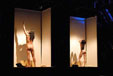
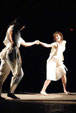
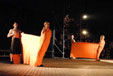
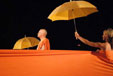
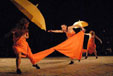
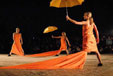
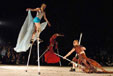
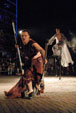
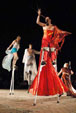
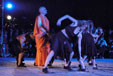
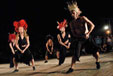
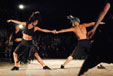
Tsunami is the large outdoor spectacle linking
to tradition of the best realizations of European
artistic street theatre, prepared in co-operation
with two theatre institutions: Music Theatre in Gliwice
and Puppet Theatre Banialuka in Bielsko-Biała.
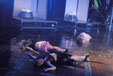
The performance tells in metaphorical shortcut the
history of family in the face of unforeseeable. It
is metaphorical story about human fate, about all
of us, dependent from elections or whims of nature,
about human race, who is prisoner of nature. The helpless
man in the face of external strengths (the nature,
God, gods, fate), insignificancy of human existence
in perspective of cosmos - this is the basic meanings
of tale. Performance came into being with inspiration
of tragic events in Asia in 2005.
The motives of oriental culture in performance were
connected from traditional and thoroughly present
the theatrical motives and styles. The spectacle Tsunami
possesses the every features of total theatre.
The spectacle is the sister-performance of our other
large scale spectacle entitled El niňo.
-------------------------------------------------------------------------------------------------
script: Marcin Herich, Krzysztof Korwin-Piotrowski
direction: Marcin Herich
choreography: Katarzyna Aleksander-Kmieć
set design: Jerzy Boduch
costumes and masks: Zofia de Ines
music:
fragment of motives of traditional Asian compositions
and works of Henryk Mikołaj Górecki, Wojciech Kilar,
Georg Fridrich Haendel and Mirosław Matyasik
acting: actors, dancers and musicians of Music Theatre
in Gliwice and Natalia Kruszyna, Monika Wachowicz,
Maciej Dziaczko, Cezary Kruszyna (Marcin Kuszej)
co-operation: Lucyna Kozień
duration of the performance: 55 minutes
--------------------------------------------------------------------------------------------------
FESTIVALS AND EVENTS
*Gliwickie Spotkania Teatralne (Gliwice, Poland, 2006)
*Międzynarodowy Festiwal Sztuki Lalkarskiej (Bielsko-Biała,
Poland, 2006)
*Międzynarodowy Festiwal Teatrów A PART (Katowice,
Poland, 2006)
*Międzynarodowy Festiwal Sztuka Ulicy (Warsaw, Poland,
2007)
CRITICS
In a theatre fiction way, but still face to face with
a substitute of a natural element got in touch the
spectators, which came in a great numbers on a Krakowski
Square on Friday, to see an opening night of an outdoor
Tsunami entertainment. And even these, who went back
home wet of the water wave didn't hide his admiration.
It was the highest quality outdoor show. A coherent,
graphical and musical tale about a human helpless
towards to a total danger. The show with spectacular
ritual dance, pantomime, with a sophisticated costume
and mask and excellent musical frame. A theatre in
its element.
Aleksandra Czapla-Oslislo, Gazeta Wyborcza
How do we act facing a disaster? What is then important,
saving our own skin or rescue other people? How difficult
choices are we forced to make in the face of a total
chaos? How much of the humanity remains inside us?
An outdoor entertainment Tsunami tried to answer these
difficult questions. In the night on a Krakowski Square
we had witnessed a meeting with a threat of cataclysm.
The actors, dancers, music and ritual masks guided
spectators into an unpredictable world of the human
behaviour.
(ml), Nowiny Gliwickie
Helplessness and dependence upon the forces of nature
is the subject of an outdoor spectacle Tsunami. (...)
The entertainment shows everything what the outdoor
theatre differs with from the traditional one. This
is a true total theatre. Special effects - fire, wind,
water are really impressive. The music is very important
too - it builds the atmosphere and intensifies emotions.
A ritual dances, with the help of which people try
to tame the forces of nature, deeply engrave in memory.
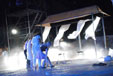
Extraordinarily suggestive are the images of birds,
that fly off the up land and a few metres wave, which
destroys everything, not having mercy on the spectators.
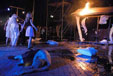
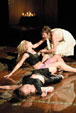
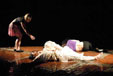
But the most painful is the final, when those who
survived search for the relatives among the dead bodies.
Danuta Lubina-Cipińska, Rzeczpospolita
The entertainment (...) tales about the tragedy that
take place on an Indonesian coast in 2005. The anonymous,
universalized story was telling about the end of the
world - ordered by a thousand years of tradition,
beliefs, culture - where people felt boundlessly safe.
When the cataclysm came, an opera music announcing
a misfortune was heard and cascades of water flooded
the scene. The spectators, safely sitting on the stairs
sprang up running away from water. Those who were
sitting above them seat still. The only thing they
could do was to move a little higher to give the place
to the soaked. Sorely ended up that day of the festival
which began so careless. Applauds and the vivas rewarding
the show testified that people still remember the
tragedy.
Eva Hevelke, Nowa Siła Krytyczna