|
|

|
 |
| |
|
THIRTY-YEAR WOMAN
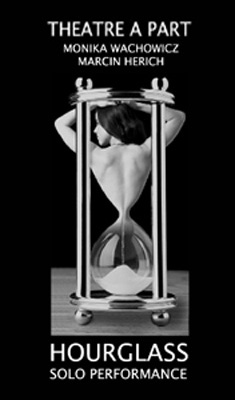
Klepsydra (Hourglass) is an intimate physical theatre solo project by actress Monika Wachowicz. The word "klepsydra" in Polish language contains two significances.
It means "an hourglass", but also "obituary notice". The performance is almost non-verbal solo, joining the poetic of theatre of body, gestures and emotions as well as elements of dance theatre.
The show is a kind of a mourning ritual, last meeting, longing. In the show we can find references to the artistic works of Milan
Kundera and Krzysztof Kieslowski.
-------------------------------------------
script, stage moving and direction:
Marcin Herich
script co-operation, stage moving and acting: Monika
Wachowicz
music: fragments of works by Archive and
Keith Jarrett
text: travesty of fragment of poem
"Thirty-year Woman" by Ryszard Krynicki
duration of the performance: 40 minutes
-------------------------------------------
|
|
|

PREVIOUS PRESENTATIONS
*Górnośląskie Centrum Kultury (Katowice, PL, first night performance,
2007.05.12)
*Kinoteatr Rialto (Katowice, PL, International Theatre Festival A
Part, 2007.06.16)
*Zamek Olsztyński (Olsztyn, PL, Olsztyńskie Lato Artystyczne, 2007.08.16)
*Klub Carpe Diem (Częstochowa, PL, Festiwal Teatrów Ogródkowych, 2007.08.19)
*Teatro Scalpello (Fiorentino, RSM, Theatre Festival Calanchi, 2007.10.06)
*Teatr Korez (Katowice, PL, 2007.10.18)
*Studio BWA (Wroclaw, PL, 2007.11.09 & 2007.11.10)
*Rybnickie Centrum Kultury (Rybnik, PL, Nocne Prowokacje, 2007.11.22)
*Kinoteatr Rialto (Katowice, PL, 2007.12.15)
*Teatr Mały (Tychy, PL, 2007.12.19 & 2008.02.19)
*Teatr Korez (Katowice, PL, 2008.03.19)
*Teatr Ósmego Dnia (Poznań, PL, 2008.03.28)
*Dom Kultury (Gryfino, PL, Festiwal Intymnych Form Artystycznych, 2008.04.12)
*Centrum Kultury (Ostrów Wlkp, PL, Festiwal Teatrów Niezależnych, 2008.05.17)
*Muzeu Etnografic (Cluj-Napoca, RO, Festival MAN.In.FEST, 2008.10.21-22)
*Theaterlabor Bielefeld (Bielegeld, D, Theaterfestival 360°, 2008.10.25)
*Kinoteatr Rialto (Katowice, PL, 2008.11.02)
*Młodzieżowy Klub Twórczy Plama (Gdańsk, PL, 2008.11.17)
*Bibliotheca Alexandrina
(Alexandria, EG, Creative Forum, 2009.02.08)
*Teatr KTO (Kraków, PL, 2009.02.13)
*Teatr Lalek (Mogilev, BY, Theatre Forum M.@RT.KONTAKT, 2009.03.24)
*Hala C (Prague, CZ, Mezinarodni Festival Nulty Bod, 2009.09.23)
*Meteorit (Bratislava, SL, International Arts Festival Meteorit, 2009.10.13)
*Fifth Theatre (Omsk, RU, Festival Youth Theatres of Russia, 2009.10.28)
*Teatr Praga (Warszawa, PL, 2010.01.27)
*Centrum im. L. Zamenhofa (Białystok, PL, 2010.01.28)
*Grodzki Dom Kultury (Gorzów Wielkopolski, PL, 2010.02.19)
*Societatheater (Dresden, D, szene: Polen, 2010.05.07)
*Tiyatro Maan (Istanbul, TY, Integral Move Festival, 2010.05.09)
*Sala Studio (Arad, RO, Underground Theatre Festival, 2010.05.17)
*Muzeum Okręgowe (Bydgoszcz, PL, Przegląd Teatrów Offowych Akcja, 2010.07.30)
*Stara ProchOFFnia (Warszawa, PL, Lalka też Człowiek, 2010.11.13)
*Klub Marchołt (Katowice, PL, 2010.12.13)
*Kinoteatr Rialto (Katowice, PL, Teatr A PART Festival, 2011.02.10)
*Klub Marchołt (Katowice, PL, Performing Arts Festival A
Part, 2011.06.17)
*St. Dominik (Zadar, CR, Festival of Contemporary Theatre, 2011.08.13)
*Theatre ROW (New York, USA, United Solo Theatre Festival, 2011.11.05)
*Teatr Rozrywki (Chorzów, PL, Teatr A PART Festival, 2012.02.21)
*Teatr Korez (Katowice, PL, 2012.03.15)
*Pinceszínház (Budapest, H, International Monodrama Festival, 2012.03.26)
*Teatr Szwalnia (Łódź, PL, 2012.05.09)
*Pozoriste Pinokio (Belgrade, SR, Festival Monodrame i Pantomime, 2012.07.06)
*Town Hall Theatre (Galway, IR, Colours Fringe Festival, 2012.07.07)
*Teatr Korez (Katowice, PL, 2012.11.12)
*Teatr w Oknie (Gdańsk, PL, 2013.11.30)
*Teatr A Part Studio (Katowice, PL, 2014.01.19)
*Dom Zdrojowy (Jastrzębie Zdrój, PL, Festiwal Sztuk Wszelakich, 2014.10.24)
*Teatr Korez (Katowice, PL, Metavera Art Festival, 2014.11.06)
*Palazzo Gambassi (Campsirago, I, Il Giardino delle Esperidi Festival, 2015.06.21)
CRITICS
I'm always sceptical about nudity on stage, not because of the prudery, but only because to my regret, nudity in theatre is groundless and it is only trying to make a poor spectacle more attractive. In the beginning I thought it will be the same with the Hourglass, but soon enough I became convinced that I was wrong. Monika Wachowicz convinced me with the last scene of her artistic vision, touched me deeply and I felt "pressed me into the chair so forcibly" that I found applause inappropriate. Not because the actress's actual play was not worthy it, but because it would interfere with the atmosphere that was created and it wouldn't fully express the emotions evoked by her.
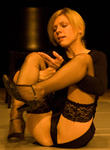
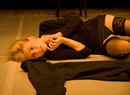
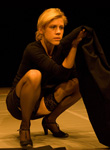
The spectacle is a reflection on time, passing by and inevitable death. It's not my job here to interpret all the artistic solutions used in the spectacle, but I would like to mention a few. Clothes played a big role. When Monika Wachowicz shows up on the scene, she wears high heels, men's trousers and the shirt. After a moment she starts to strip, but it becomes apparent that underneath she wears another blouse and a skirt. She arranges men's clothes on the floor with perfection and tenderness. They could symbolise a beloved person taken by death. For me personally it is a metaphor of something else - a woman saying goodbye to some part of herself, that is lost forever. She loses other layers, which had grown upon her with time, to show us at the end of the spectacle the whole truth about ourselves. If we look closer at it, the spectacle can be seen as a study about femininity, her condition in culture, reflection on her masculine and feminine element. When the actress loses the rest of the clothes, it is a metaphor of her slow death - not only her organism is dying, so is her soul, and in some cases the soul of a man dies much sooner than the body. In the last minutes of the spectacle, the actress stays naked, but she doesn't let us look on herself as something seductive or attractive. The body has been shown as something material, as something worthless. Wachowicz shows us the whole brutality of nudity, the limits of human body, its weakness, ugliness and helplessness. An additional factor, moving the audience's imagination, is the short fragment of Ryszard Krynicki's poem titled "Thirty-year Woman". It is a very personal confession of pain and lack of illusions. Of a woman suffering and looking for comfort in suicidal death. Monika Wachowicz played honestly and truthfully. She was faithful to her role. It's hard to find out how much of it was a fiction and how much the true experiences of the actress herself.
The close contact she kept with the audience didn't let us being indifferent or distanced to what we had seen on the stage. The actress publically stripped not only her body but also her soul and that requires a great courage.
Barbara Wojnarowska, Dziennik Teatralny [Katowice, Poland]
Hourglass is a chamber spectacle, a study of a woman suffering in form of the dance, gesture and body. A touching project of Teatr A PART is the reflection of time passing by and the inevitable end, death. Hourglass is a study about suffering in loneliness. Woman going through the loss of men. When she shows up on the scene, she wears men's trousers and a shirt. After a while she takes them of and arranges the jacket and trousers on the ground. The clothes signify a men, who is not there. Actress is doing the same movements, perfectly performing each of the movements. She fills theatrical space in the rhythm of the music so it will fill the emptiness of solitude. She is hypnotising the audience with gesture, mime and emotion, which she performs. The movement and emotion expressed trough her body say much more than the words. Woman is saying goodbye to a feeling, the men, who disappeared from her life, taking some part of herself. By losing her clothes she cleanses herself emotionally. She discards off her clothes as she would the burden and pain filling her inside. The movement and gesture are combined with the music, which expresses the notion of the spectacle. The actress strips off in time to the music, as she discards her clothing, she slowly dies. She can't bear the loneliness. She can't forget about the men and the pain which fills her. Monika Wachowich touched all the audience deeply. She is faithful and true to the struggle she performs. The perfect performance of the artist is the high point of the spectacle. With her body she shows the passing by of time, which kills the feeling and the man. The hourglass measures the time, the actress measures the suffering and pain. Hourglass is a great spectacle expressing the emptiness that can not be filled. Love ends like life ends. Death or loss of a beloved one causes a pain, which you never lose. It is a burden that has to be carried everyday. Time heals the wounds, but can you forget?
Agnieszka Manowska, Dziennik Teatralny [Katowice, Poland]
The last spectacle of the festival was Hourglass performed by Teatr A Part. It's hard to pass by indifferently to the spectacle presented at the festival, but telling a story about it won't be enough, as words cannot describe the accompanied emotions. Most certainly the performance was about the emptiness and loneliness, but also about inability to understand and overwhelming pain, probably after losing a men. Nudity of the actress exposed to the audience for a long was in this case fully justified. After taking off a men's clothes, and then woman's dress, the actress became denuded. Her very self has been the only mask, the form alone marked her identity and when it was gone, releasing of completeness became impossible to achieve. And only overwhelming emptiness was left.
Zuzanna Mikołajczyk, Dziennik Teatralny [Ostrów Wielkopolski, Poland]
The presentation of the spectacle Hourglass of the A Part in the solo act of Monika Wachowicz in Ethnographic Museum in Cluj-Napoca during Man.In.FEST Festival left a strong trace in audiences minds. It is rare to see a spectacle that will function so well and act on people, abstracting from the whole discussion about its concept and timing of the play.
Here we deal with - at last- the story. The story shown is a continuation of relation between woman and men, leading to a painful end. The actress on the empty stage, primarily dressed in the men's clothes, in the final sitting naked on the floor, arranged on the floor black, rejected clothes becoming an empty form after lost men. The men has died. In polish the word "hourglass" means also "obituary notice". Under pressure of her own memories, the actress is performing an erotic ritual for her absent, lost men. Through out illusion, made by the play, all her almost private gestures are not worthless and come to have universal meaning. Only when naked does she become fully feminine again. Practically everything that's happening on the stage is the gentle ritual of solitude and human helplessness. Some of the audience have been disappointed with the rhythm of the story accusing it of fluidity, simplicity and predictability. Others, like I, were seduced seeing the intimate movements, very touching interpretation of human behaviours and perfection of the gestures. I simply liked the spectacle, especially few of the choreographic effects and visual metaphors (i.e. fast and faster movements of actress's legs in the shape of the clock, symbolising brutality of the passing time) as well as the acting of the actress together with the music. Music accompanying the spectacle (recorded improvised jazz piano concert) amplified the drama.
The spectacle has won the recognition prize of the committee of the Independent Theatre Festival in Poland in 2008 for "being uncompromising in showing emptiness and loneliness". On the festival in Cluj-Napoca it deserves the prize for "the first spectacle shown on the festival in which I've seen truly working theatrical expression".
Florian-Rareş Tileagă, agenda.liternet.ro [Cluj-Napoca, Romania]
Monika Wachowicz's solo act in the spectacle titled Hourglass is concentrating on showing different forms of solitude. In the last phase of the spectacle built on slow, simplified movements and minimal use of decoration or costume, attention of the audience is focused on the inner spiritual vibrations. The dancer of polish Teatr A Part does well with just single men's shirt and trousers to tell the story about feelings of dominant emptiness. Her dance includes simultaneously being full of joyous feeling of freedom and also mourning grief.
Musca Szabolcs, www.hamlet.ro [Cluj-Napoca, Romania]
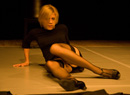
The reception of Hourglass by the Polish Teatr A PART, was equally exciting but in a totally different key. Inspired by a poem called "Thirty-year Woman", a dance and movement poetic piece, featured the suffering, frustration, anger and despair of an abused, betrayed and terribly lonely woman who tells us at the end: "My annihilation comes true continuously/Since then I seek my friends among the dead only/Inside me/ And among the forgotten." Austerely dressed in a long-sleeved black shirt and blac trousers, Monika Wachowicz at first paced round the space in measured steps, occasionally tripping and performing some ground movements in which she bent her body extremely backwards and, supporting her self on one hand placed on the floor, revolved it horizontally, hitting the floor hard as she went round and round in that position with the feminine, high heels she wore so that they became the focus of the exercise.
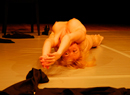
The rest of the performance consisted of an act of gradual striptease in which the black shirt and trousers went first, followed by the miniskirt and revealing top she wore underneath, then by the underwear. Though there was no hint of titillation in the dancer's movements or the music which accompanied them, and though her thin and childish body seemed quite frail and pathetically vulnerable as it was gradually stripped of its protective covering, you could feel the tension building in the auditorium and hear suppressed giggles. When the dancer sat quietly on a chair, facing the audience, and looking pensively at the black shirt and trousers she had earlier carefully laid on the floor in the shape of a supine male figure, then proceeded to take off her bras, some people edged forward in their seats, some actually gasped and a number noisily left.
Though I liked the performance and thought it quite moving, the reaction of the audience provided a more thrilling drama which vividly reminded me of the tense excitement of an Iranian audience during a performance in Teheran when the wig worn by one of the actresses slipped back a little, momentarily revealing a bit of her real hair before she quickly pulled it back. Writing about this wig incident several years ago, I said that though it was accidental, yet it was the most daringly experimental moment in the whole of Al-Fajir Iranian festival. As for me, I was positively delighted that director Marcin Herich, the founder of the Teatr A PART contemporary visual and physical theatre group had shocked some and discomfited many. Such feelings are rare in theatre nowadays and I was grateful to the Forum in Alexandria, and to Doma, for showing more courage, artistic integrity and daring than the organizers of the Cairo International Festival for Experimental Theatre could ever be capable of. The CIFET who would never have admitted Hourglass in the first place, or would have heavily censored it if they did. Chapeau then to the Forum in Alexandria and to Doma.
Nehad Selaiha, Al-Ahram Weekly [Alexandria, Egypt]
The woman's fragile, her dress is to baggy. When Monika Wachowicz stepped on a stage from the dark - why was I sure this going to be a story about loss? I don't know. Was it a single gesture that I didn't catch. Maybe a half of a step? Or was it a smile - strange, indistinct, hard to catch? Probably. And it was clear (at once?) - he's gone. Stopped loving? Left? Hit the road, insensitive? Perhaps. But I wish to think he's dead. The fragile woman doesn't want a stillness. She's dancing. Wachowicz's dancing monodrama consists of imperceptibles, only a filigree gestures, no importunate unequivocals at all. The fragile woman knows, that one ought to dance in a low voice on ashes. So that way she takes off the baggy dress, that way she pulls her legs from wide trouser and the same way - whispering her fingers - she throws away skimpy skirt, scant shirt, lacy finish stockings, bra and finally panties. She stay naked. Yes. With invisible, fresh trace of his shirts seam on a skin of her shoulder. She takes off an empty objects that's left after he's gone and lays them down to the floor so they make a shape of a flat figure. By impossibly delicate gesture she lifts up a black cuff, rubs it with her fingers, sniffs it, puts down. And then - a faint smile, just for a second, somewhere between an eye and a lip corner. That's all. And let this be enough. That's more or less how a forty minutes striptease of the fragile woman looks like.
Paweł Głowacki, Dziennik Polski [Cracow, Poland]
The idea of the Hourglas is to show a world of memories, nostalgia, despair after a lost person. The character is a woman, the instrument is a body in motion, irreplaceable by any word. After entering the auditorium you could have impression that everyone were suspended, awaiting something unusual. It was such a situation, when, observing an event, you watch the others stealthily to confirm that you behave a right way. There was no dimmed light, no shade, no props to hide a naked woman. Only a man's clothes and looming femininity. All ruined while the time passes by. Cause the Hourglass is a voyage around indescribable loss, it's tearing off pieces of memories that once filled each form. The story is so much intense, for it relates or will relate to each of us. The performance attacks the audience by overpowering dose of helplessness, resignation and sorrow, which, although the performance is a few years old, still looks authentic on the actress face. And enormous dose of sensitivity.
Piotr Barański, www.madeinbialystok.com [Białystok, Poland]

Photo: Małgorzata Wachowicz
|