SENSACIONALE GRANDE FINALE
Hans Bellmer - German surrealist and scandalizing artist. His creation merged sexuality with lining to disintegration, degradation, death. Bellmers creation central motif was naked or semi-naked doll, which in hands of male artist-demiurge undergone tragicomic, often cruel transformations. Born, like Herich - the performance director, in Katowice. They both graduated the same secondary school. In Bellmers creation, like in Teatr A PARTs performances sex and death interlock. This creation stands aloof from temporariness and realism, and at the same time autobiographical, carrying experiences, fascinations and fears towards illusion and transcendence. Hans Bellmer died in 1975. The same year Tadeusz Kantor for the first time staged his incredible The Dead Class. Bellmer is exceptionally nice name for a circus.
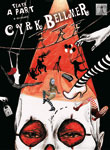
Cyrk Bellmer - poor circus of Teatr A Part, circus about dying, freak show, stretched out between entertainment and dead, erotic and burying of dead, circus in a graveyards warehouse, on a memories rubbish dump, surrealistic-fatalistic cabaret, grande massacre, "the lowest culture" spectacle. Dedicated to these who had or will gone.
PRESENTATIONS
*Kinoteatr Rialto (Katowice, 17.11.2011, first night performance)
*MDK Bogucice-Zawodzie (Katowice, 23 & 25.02.2012, Teatr A Part Festival)
*Teatr Mały (Tychy, 19.05.2012)
*big top on Plac Litewski (Lublin, 25.05.2012, Central Europe Theatre Festival Neighbours)
*Kinoteatr Rialto (Katowice, 21.06.2012, International Performing Arts Festival A Part)
*Kinoteatr Rialto (Katowice, 11.10.2012)
*Kinoteatr Rialto (Katowice, 28.05.2013)
*Jeleniogórskie Centrum Kultury (Jelenia Góra, 31.05.2014, Festiwal Pestka)
*Kinoteatr Rialto (Katowice, 12.06.2014, International Performing Arts Festival A Part)
*Hajnowski Dom Kultury (Hajnówka, 3.08.2014, International Theatre Festival WERTEP)
*Kinoteatr Rialto (Katowice, 12.06.2015, International Performing Arts Festival A Part)
--------------------------------------------------------------------------------------------------
concept, script, direction and set design: Marcin Herich
script co-operation: team of the performance
acting: M. Katarzyna Gliwa (Karolina Narazińska), Natalia Kruszyna, Joanna Pyrcz,
Monika Wachowicz, Cezary Kruszyna, Marek Radwan, Lesław Witosz
set co-operation, production: Cezary Kruszyna
music: fragments of works by Olafur Arnalds, Social Interiors, Kato Hideki, Skuli Sverrisson Hanka Ordonówna and traditional circus music
duration of the performance: 75 minutes
--------------------------------------------------------------------------------------------------
CRITICS
The Teatr A PART specific is an expressive, physical acting, an intense presence of the actor as a body. Based on extracting its morphological, individual attributes, a stylistics of theatre of body and emotions can be constructed. Taking the advantage of creative potential of living human tissue and an immanent dramaturgy contained in it, the performances profit by an authenticity. Teatr A PARTs authors are interested in imponderables, that is "something" - this what you can't describe nor comprehend, and which has an enormous meaning and a power of subconscious influence on human beings behaviour. Marcin Herich's performances don't really describe a mysterious phenomenon - they try to catch its boundary character. Thus they initiate new ways of understanding humans existence, expanding limits of our experience.
Cyrk Bellmer performance is an obvious reference to unusual personage of Hans Bellmer. What made a younger artist to start a dialogue with an elder's heritage is an obsession of worlds omnipresent dichotomy of life and dead, sacred and profane. The director brings to life Bellmer's dolls, in order to, in a drastic ritual according to law of nature, kill them again. Took out from a primary context they are thrown on a circus arena. This surrealist space full of weird creatures is the only place when, as a freaks of nature, they can exist. But a Frankenstein's creature frees itself from its creator and begin to live its own life, being menace. Therefore it must be annihilated. Dead however doesn't mean the end of existence, as one body switches fluently into another one. Something dies continually, to give another life.
We witness a repeated ceremony, accomplishing by a symbolic sequences of formalized gestures. They are related to a phenomenon of taboo and fetish of a females womb. The dolls act unwittingly, guided by a map of memory depicting a topography of their own bodies. The main points are marked out by a wet body cavities, like eyes, mouth or vagina. These are an erogenous zones, connecting entrails with this, what is external to body. Mannequins, deprived of their own initiative, lustfully prone and very plastic, undergo all impulses. Their bodies constitute an outlaw territory, open to every kind of demiurgic manipulations. Under duress and supervised by torturers, conducted on strings marionettes show a huge range of expression. From howling in desperation, by a frenetic delight they reach a cruelty, mourning and finally death visuality of the mystery was arousing a various reactions of the spectators. One were trying to avoid watching, other opposite, were revelling of the view, moving their eyes to see as much as possible, nearly falling down from their chairs. Boundless and exhibitionist nakedness was but fully justified and far from consumer, light erotica. Without it the performance would lose its sense. This metaphysical orgy began from an innocent fun but turned into initiation accomplished by an act of violation. The situation, played live, touches and awakes mans animal instinct. Destructive and fertile at the same time exist not beyond right and wrong, but among them. We witness as living toward death instinctively fights for survival. Females holes, being a source of suffering, utter a silent scream, which is impossible to free from for a long time after leaving the performance. The experience is so strong, that bewildered spectator doesn't know how to distance from what he's just seen. The staging disturbs some kind of humans constant and perturbs an internal moral imperative. And stupefied he's losing the sense of direction. Doesn't know how to comprehend the performance and how to keep on living after that...
Agata Goraj, Portal Katowicki, [Katowice, Poland]


Doll, that is submission and distance. The obscure object of imagination – in a nursery room and in the high life. The muse of surrealists. Objectified hyperreality – not once, and each time in a different way, though frequently in a conscious collective of unconsciousness: Bellmer amputates and multiplies it’s members, to photograph them after that, Eluard lends them his voice – creating a poetry to Bellmer’s sessions, Herich dresses it up in body and sets in motion. In Bellmer Circus the audience is only a camouflage.
Four women step out from the auditorium to the stage. On the threshold one of them turns and touches (pinches?) a spectator from the first row. Now it’s clear – it’s a being of flash and bone. Here everything happens “really”. You don’t watch the Bellmer Circus. You live in it. In a total slavery of the body and the imagination. To avoid any doubts – the arena is surrounded by a barbwire – invincible one. But Circus Bellmer is not a doll house (camp?). Out of a chair above the arena (throne?) the emptiness emanates. Circus Bellmer is a domain of dolls. And anagrams of body.
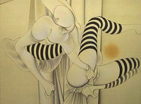
Legs, legs, legs and one more time legs – in a schoolgirls, black-and-white knee-length socks. In a vertical reflections (alongside belly line) and angles: acute, right and obtuse. Herich’s actresses, in a draughtsman’s precision, multiply and amputate lines, bends, and convexities of body. They create an odd constellations of corporal repetitions – Bellmers identification mark. As if himself implanted in place of their joints a ball-and-socket joints. Fidgety starfish of eight legs (copies of arms) is a reality, not a dream. And just a beginning of surreal multiplication table in Herich Circus. Director, since, complicates and combines Bellmers operations on body – strains a puppeteers fantasies through a subjective filter of his own imagination. And auto irony. Giggling teenage girls are checking themselves in the mirrors of the clowns sculls with ghastly incisors, rubber gloves in outstretched claws, a subtlety in grotesque and melodrama – mood swings (with fireworks) is a star turn in Marcin Herich’s circus. What’s more, a body, quoting itself, infects circus’s exterior. A lips-vagina transfer echoes in a spread curtain and a gaping coffins lid. A lover, a coroner, a director. Original copies unlimited.
Unlimited - cause a doll has its own world at Herich’s. And imagination. Constellations of black-and-white, stripped stockings turns suddenly in a gallop of stampeded zebras. And in a new, spontaneous configurations – a “convulsive beauty” from Bretons postulate. Admittedly, whipping big-bellied zombies (in a clowns make-up) plus abracadabras of dadaist-illusionist (fantastic Cezary Kruszyna, Marek Radwan and Leslaw Witosz) put the dolls upright, but just for a moment. It’s not taming, but wrestling. By turns with drill and “Heil Hitler”, the dolls enjoy indulging in anatomic fantasies. Psychodely from Francis Becon’s arena on a set of Buster Keaton’s slapstick. It’s hard to judge whether to laugh or cry in a Bellmer Circus unlimited.
Herich’s dolls don’t bother – they hide their heads (and reason) behind the rest of their bodies, or cloth and mask. And even so they make – with a technical precision – breakneck acrobatics. To perverse Hanka Ordonowna’s words: “what I’m longing for today, what I’m dreaming of today, you can read this thought from my face”. How to understand it? “You can understand it by your heart” – sings next Ordonka – on Herich’s note. Cause body in Bellmer Circus feels, thinks and fantasizes to the full extent, in-depth and unknowingly. It gets out of an outer, superior control. “It’s not a head alone invented the mathematics” – repeats Herich after Bellmer. And he treats to legs a repeated coming out. And to the audience – after consecutive repetition – a hypnosis. Accompanied by a clattering barrel organ, in a stunning spot light and intoxicating red colour on the stage (curtain, wine, lipstick, cemetery harpies and wreaths) an unconsciousness wakes up, and along with it - visions and dreams.
So that Herich’s performance is a ball-and-socket joints in a joints of audience. Stimulates and embodies the imagination. And sanctions a dream (doll), suspected of being a fiction. Subtly and forthrightly, nostalgic and giggling, half-jokingly and half-seriously, with Bellmer and without him. And hence all that circus: “relationship endowed with realism absolutely higher [than reality], for at the same time subjective and objective” - citing Hans Bellmer, but in Herich Circus Limited.
Monika Gorzelak, Dziennik Teatralny [Katowice, Poland]


The Cyrk Bellmer performance by Teatr A Part was inspired – as the title indicates - by Hans Bellmer works. This inspiration encouraged me to wait for the performance and to see it. I think Bellmer is an interesting author and worth to dredge up from some kind of non-existence, wherein he still remains in Poland. I began to get to know his art rather long time ago, at the beginning of the nineties.
First there were his distressing but intriguing drawings, that were used as illustrations to then published “Story of the Eye and other stories” by George Bataille. Only later on I “discovered” for myself his earlier sculptor installations, making use of dolls, which made them famous the most. I mention this first meeting with Bellmer’s not incidentally. Knowledge of his drawings let us better and deeper dive in the performance matter. I would risk an assertion that they can be treated as a peculiar comment – I don’t know: conscious or not - upon his entire earlier works. As well as they comprise this inseparable connection between Eros and Thanatos, which is an axis of the performance. The A Parts artists has very aptly and deftly translated into theatrical language (because against some fears, which I felt a priori, it was the theatre) Bellmer’s creations aesthetics and climate. They enlivened his sculptures and drawings and put the characters drown out from them in an odd point, where cheap amusement meets connects with death. The world is sad, gimcrack and not seldom obscene circus, they seem to tell us, and we have no other choice than performing in it. And we have no certainty, that there is any difference “on the other side”. An emotional intensity and suggestibility of the performance has made me unable to free of it till now.
Andrzej Z. Kowalczyk, Kurier Lubelski [Lublin, Poland]


Fact, that Bellmer’s dolls, extremely expressive and provocative, present an interesting theatrical material, was proven by A PART’s performance, which refers to the artist already in its title. Also in Bellmer Circus appear a lot of his installations and sketches, and not presented as props only, but all animated, created by four actresses. The characters created by him are humans caricatures – sorely deformed, thick and swollen or abnormally thin – freaks, which find their place in circus. That’s why this space was chosen by director Marcin Herich to locate his performance in.
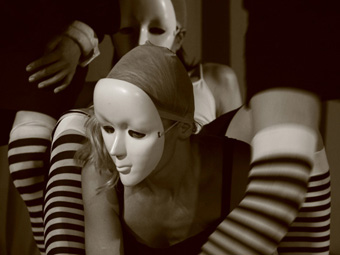
Then, apart from clowns and manager-illusionist, on the arena (fenced by a barbed wire!) appear them – clothed in ballet dancers dresses, but completely devoid of their grace, awkward. Unable to perform a simple circus numbers, such us springboard or skipping-rope jumping, spinning a hula hoop, or walking a tightrope that lays on the floor. Their black-and-white stockings and high heels are nearly taken alive from Bellmer’s drawings. This indeed Bellmer’s climate the artists maintain in a following scenes too: women in white masks and their hair waited on one side are peeping one to another underneath their blouses, dancing with their panties lowered down their ankles, throwing an underwear took off one of them from hands to hands. After that they appear dressed in a red, rubber capes and huge red, rubber gloves – wearing them one time on their hands and other time on their feet. And when they are putting monster masks on their faces, again they look like eyesores, pictured so much willingly by the artist born in Katowice. The circus, however, which they perform in, is not funny at all – it is depressing, terrifying. Even quite amusing clowns, who are forced to participate in this gloomy entertainment to perform grave-diggers, don’t make the situation any better.
The fatalistic show goes on and women emerge on the stage again. They enter dressed in white shirts, with glasses of wine in their hands. Unrestrainedly laughing they start a frantic dance - they are spilling the wine, tearing their cloths, painting their bodies in a red lipstick. It turns out that they are half-naked – when they sit down on chairs spreading their legs, in ragged shirts and “bloody” bodies, they again become an embodiment of Bellmer’s surrealistic visions. Women draw near to death and now an important part plays a sand/dust (thrown earlier on the stage by the clowns–grave-diggers), which they are pouring to the glasses and even eating. This scene is visually the performances’ most interesting one – the actresses are wrapping their heads by remains of their shirts, by means of lipstick they are drawing a face on them and they are “biting the dust”. As after each scene they are hiding behind the curtain, but this time – for good. The clowns are covering empty coffins located on each side of the stage and laying flowers and candles on them they are saying a symbolic burial ritual.
The performance in an interesting way takes an advantage of symbols used by Bellmer – nakedness, ugliness or obscenity. Although consecutive scenes differ one from another in aspect and behavior of “animated dolls”, they are characterized by some repeatability, even deeply stressing an ill-fate of circus. Since its message is not optimistic – the circus brings a doll to life, just to take it away at once. What an irony of fate!
Agnieszka Misiewicz, Teatralia [Katowice, Poland]