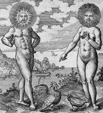
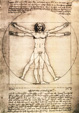
The performance entitled FAUST is the third part of the outdoor Trylogy of Existance by Marcin Herich & Teatr A PART, however completely autonomous. The performance is not only adaptation of famoust writings, i.e.: "The Tragical History of Doctor Faustus" by Christopher Marlowe or Faust by Johann Wolfgang Goethe. The legend of Faust and Mephistopheles with alchemic elements shows everyman in duality of soul and body, sexuality and feeling of death, knowledge and emotions. This men was showed in a melodramatic situation of unsuccessful and sick love, anarchy of mind because of crazy emotions, out of control. In the face of such feeling rational part of mind start to be broken. Mephistopheles is not a real devil. She is a women, protagonist of sick imagination of Faust, his devil and witch, his Margaret and his beautiful and cold Helen of Troy. This Sabbath of madness in Faust's head drives to calamity. The story has connections to philosophy of existentialism. Faust will not go to the hell but ordinary die.
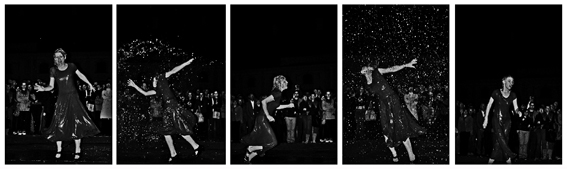
The performance is created in the same aesthetic way like two previous parts of the trylogy: FEMINA and EL NINO. Moving constructions, stilts, smoke, water, open fire and physical acting are applied in a show, but no word is spoken.
-----------------------------------------------------------------------------------------------------
scenario, direction, staging: Marcin Herich
actors:
Natalia Kruszyna, Joanna Pyrcz, Monika Wachowicz, Jakub Kabus, Maciej Dziaczko, Cezary Kruszyna, Lesław Witosz, Dariusz Piotrowski, Marek Radwan
costumes: Natalia Kruszyna
light design: Maciej Dziaczko
music: fragments of the works by
Autopsia, The Dead Hours, C-Schulz, Dark Sanctuary, G. Santaolalla, E. Goldenthal,
R. Sakamoto, M. Matyasik, Nat King Cole
duration of the performance: 60 minutes
------------------------------------------------------------------------------------
FAUSTUS: First I will question with thee about hell.
Tell me, where is the place that men call hell?
MEPHIST: Within the bowels of these elements,
Where we are tortur'd and remain for ever:
Hell hath no limits, nor is circumscrib'd
In one self-place; but where we are is hell,
And where hell is, there must we ever be:
And, to be short, when all the world dissolves,
And every creature shall be purified,
All places shall be hell that are not heaven.
Ch. Marlowe,"The Tragical History of Doctor Faustus",
Scene V
FESTIVALS
*Days of Contemporary Art (Białystok, Poland, 2009)
*International Theatre Festival A Part
(Katowice, Poland, 2009)
*International Festival Art of the Street (Warszawa, Poland, 2009)
*Waves Festival (Vordingborg, Denmark, 2009)
*International Theatre Festival A Part
(Katowice, Poland, 2010)
*Połczyńskie Impresje Teatralne (Połczyn Zdrój, Poland, 2010)
*Theaterfestival am Fluss Sommerwerft (Frankfurt am Main, Germany, 2010)
*International Festival Art of the Street (Warszawa, Poland, 2010)
*International Performing Arts Festival A Part (Katowice, Poland, 2011)
*Night of Theatres (Kraków, Poland, 2011)
*Przyjaciele Nowego Wychodzą na Ulicę (Łódź, Poland, 2011)
*International Festival Teatromania (Bytom, Poland, 2012)
*International Performing Arts Festival A Part (Katowice, Poland, 2013)
*International Performing Arts Festival A Part (Katowice, Poland, 2014)
*Night of Theatres (Kraków, Poland, 2015)
*Midsummer Night of Będzin (Będzin, Poland, 2015)
*Tyski Festiwal Teatrów Niezależnych Adromedon (Tychy, Poland, 2015)
*Days of Polish Theatre in Tehran (Tehran, Iran, 2016)
CRITICS
A diabolic story of an agreement between Satan and Faust the Teatr A Part's Faust treats rather residually, stressing a love story and a drama of destroying innocence. But in this outdoor performance the plot is not as much important as an opportunity of creating, on spectators eyes, pictures telling about man's dilemma of choosing between right or evil, between sexual drive and a hunger for cognizance . A lot of such a pictures concocted by A Part was extraordinary suggestive: hideous, several-legged death - like on Bosch's paintings or woman flooded by the jets of water, trying to break through the lovers brain. The performance, although it was long, was fascinating to watch and intriguing in terms of aesthetic. Nowadays theatre, frequently quite unnecessarily, tries to attract spectators by nakedness. The nudity of actresses in Teatr A Part's performance was not only justified - it was beautiful too. The audience was contemplating the performance in silence.
Monika Żmijewska, Gazeta Wyborcza [Białystok, Poland]
The Faust of Teatr A Part went splendid. The actors, by means of fire, water and moving stage design created an intriguing sequence of images, accompanied by beautiful music and premeditated choreography.
The drama plot was firmly cut out. But it wasn't effect of coincidence. The artists decided to concentrate on the love story and position of main character. The world of Faust, according to the Teatr A Part is the world of evil. There is no place for God and Mephistopheles'es haggles here. Instead there are demons and temptations. In this worthless world the Faust's lot is forejudged. And in this meaning the Teatr A Part's performance makes a story of a weak human condition, his inability of making choices. The Faust's character structure is interesting itself. He was split into two actors here. The young Faust is self confident. The old one is weak and frightened. Due to such denouement, at once we can see how much the main character changes. The Teatr A Part's Faust makes the spectator think. Once again the Teatr A Part has proven, that in the street art, except the entertainment, there is a place for the reflection too.
Alicja Dzierzbicka, www.sztukaulicy.pl [Warsaw, Poland]
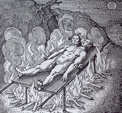
Faust as a Teatr A Part's character is a man hesitating between different forces, physical and mental, possessed by his own wishes, desires and urges. An internal fight, taking place in the character's psyche, the Teatr A Part draws with full pomp. The artists generously lavish impressions, by each scene driving the audience into astonishment. It begins harmlessly from a pantomimic scenes of dance and struggle and comes to an end by hanging the main character, in front of the public, on high, metal construction, burning at the bottom. And in the meantime: the stage drips with water, Faust goes to the burning circle and some pictures of bare bodies, naked deaths and drunk devils appears. The strength of the performance comes from overcoming successive barriers. The physical boundaries seems to be surpassed and the social taboos broken. The Faust affects the spectators by a different means, moves by its music, breadth , details of performance. It grows to a peculiar mystery. And bewildered spectator takes part in full of amaze and authentic emotions wander to the characters interior. And by the way - looks deeply into his own.
Sylwia Grygorowicz, Teatralia [Katowice, Poland]
The Teatr A Part's Faust neither bewitches nor delights. It's literally absorbing spectators. Tangible, essential matter of the performance, teamwork skills and in the same time an expressive, individual actor's creation. In addition - inventive scene sets, giving a significant staging capabilities, excellent music coexisting in images and particular scenes creating a small workmanships by themselves. Surge, lyric, painful and soothing - the scene contrasts forms one, formally coherent spectacle.
The Faust's world is a no-man's land, prohibited place, where nobody goes on he's own free will. His struggle with himself, with an inferno of his own, his desires, lusts, sins, finally his defeat - it fascinates and terrifies. The spectator, through the fear of the terminal sentences reaches an infantile simply truths about humans vocation to a good life. We, spectators, are suffering with Faust and this experience doesn't clean us up. It bares us and touches deeply. I also believe, that the performance illustrates intentions and visions of its creators - a theatre of an emotional truth, intellectual depth and sincere, good acting.
Hats off. Heady, thrilling performance. A good theatre.
Małgorzata Kowalska, www.sztukaulicy.pl [Warsaw, Poland]
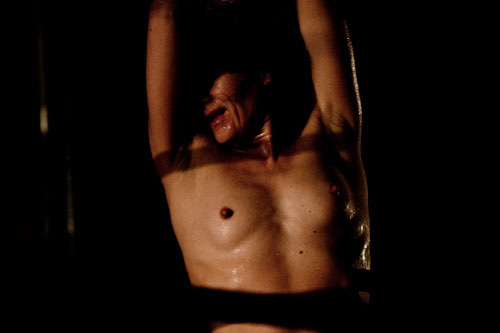
Photo: Jacek Lidwin