TO MUDDY DEATH
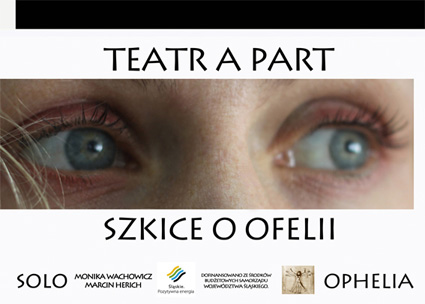
Ophelia is a chamber indoor solo project, acting by Monika Wachowich and directed by Marcin Herich. The spectacle joins the poetic of theatre of body, gestures and emotions. The spectacle is an intimate visual theatrical seance, in which the main role is played by the sound, movement and intensive stage presence of an actress. In the performance - which was created mainly by method of "writing on the stage" - the artists explore the naivety and innocence in confrontation with the realities of existence, sexuality and death context. The performance is not only adaptation of famoust plot of Hamlet's beloved from Shakespeare's drama. Myth of "Ophelia" is a clue and path for independent stage narration.
In the performance we used fragments of "Hamlet" by W. Shakespeare, short poem "Ophelia" by M. Pawlikowska-Jasnorzewska and live verbal improvisation.
----------------------------------------------------------------------------------------------------
script, stage moving and direction: Marcin Herich
script co-operation, stage moving and acting: Monika Wachowicz
music: fragments of works by Pablo's Eye, Ophelia's Dream and Elliott Goldenthal
duration of the performance: 40-45 minutes
----------------------------------------------------------------------------------------------------
PRESENTATIONS
*Aeroklub Ostrowski (Ostrów Wlkp, PL, Festiwal Teatrów Niezależnych, 2010.05.22)
*Kinoteatr Rialto (Katowice, PL, International Theatre Festival A PART, 2010.06.20)
*Kinoteatr Rialto (Katowice, PL, 2010.09.16)
*Centrum Kultury Katowice (Katowice, PL, 2010.12.16)
*Teatr Mały (Tychy, PL, 2010.12.21)
*Teatr KTO (Kraków, PL, 2011.01.13)
*Centrum im. L. Zamenhofa (Białystok, PL, 2011.02.05)
*Kinoteatr Rialto (Katowice, PL, Teatr A PART Festival, 2011.02.11)
*Santa Maria dei Battuti (Cividale del Friuli, I, Mittelfest, 2011.07.13)
*Chorzowskie Centrum Kultury (Chorzów, PL, Teatr A PART Festival, 2012.02.24)
*Teatr Korez (Katowice, PL, 2012.04.18)
*Kamerinis Teatras (Kaunas, LI, One Actor Theatre Festival MonoBaltija, 2012.05.11)
*Town Hall Theatre (Galway, IR, Colours Fringe Festival, 2012.07.07)
*Teatr w Oknie (Gdańsk, PL, The Gdańsk Shakespeare Festival, 2013.08.04-05)
*Teatr A Part Studio (Katowice, PL, 2014.01.26)
*Teatr Dzieci Zagłębia (Będzin, PL, Będzińskie Spotkania Teatralne BEST, 2014.04.11)
*Ośrodek Kultury w Będzinie (Będzin, PL, 2014.05.17)
*Pszczyna Hospital (Pszczyna, PL, Teatralna Maszyna Pszczyna, 2014.06.22)
*Theatre Centre "Ma Strastnom" (Moscow, RU, Int. Theatre festival SOLO, 2014.10.03)
*Teatro Studio (Rovigo, I, Be@Home, 2015.04.17)
*Republika Sztuki Tłusta Langusta (Poznań, PL, Inwazja Barbarzyńców, 2015.04.21)
*Pasaż Kultury Andromeda (Tychy, PL, Festiwal Teatrów Andromedon, 2015.08.23)
*Teatr A Part Studio (Katowice, PL, Sabat. Różnorodnie, 2016.01.23)
CRITICS
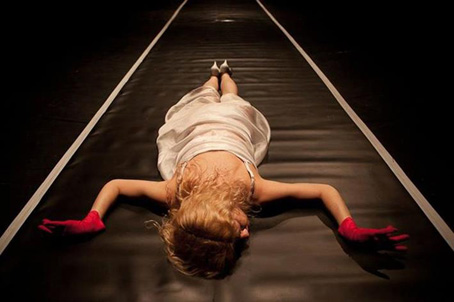
Teatr A Parts Ophelia was depicted in three - the most symbolic to the culture - colours: white, red and black. White is a girls dress, her shoes, as well as her wreath - an eternal symbol of innocence. Blood-red are Ophelia's lips and her gloves. Black is the stage - a thin belt, closed rectangle, dark space of madness and death. In this performance Ophelia's insanity takes dark, distressing form. The girls madness have nothing in common with running on a meadow and singing meaningless songs - it is a thrilling study of lonely and rebuffed woman.
Although the performance unambiguously relates to Shakespeare's Hamlet and uses it's fragments, it absolutely isn't the drama staging. A prototype of Shakespeare's heroine becomes rather an impulse to tell a separate, completely independent story. If in Shakespeare's performance we couldn't be sure whether the two young were really lovers, in Ophelia there is no place for such doubts.
Marcin Herich's performance does not stand aloof from scenes strongly emitting dark and controversial eroticism. Red gloves on the actress hand gather here entirely individual status, transforming to a males hands, daringly wandering on a females body. Whiteness and red, innocence and nude body, rejection and love, madness and death permeate, creating here a disturbing collage.
Above all, Herich's performance stresses the music and the body language, deep expression of gesture.From time to time Monika's Wachowicz acting can be seen as overdrawn, intimate to boundaries, it can even irritate - but surely it doesn't leave the spectator indifferent. This Ophelia's story was drawn by a sharp, jagged line, as when - being extreme on emotions - pencil nearly tears paper, and we're ready to wonder, that it's not bleeding.
Magdalena Iwańska, Dziennik Teatralny [Katowice, Poland]
What 's the matter with this? If this is a staging, it's just pretending. There's no clear partition to auditorium and stage. Ophelia incidentally appears among the audience and not, which is important, before them, and one by one gives everybody an interested glance and smile of Monika Wachowicz. And it's Ophelia-Monika who watches her audience, not vice versa. These contractual spectators, besides being observed by the actress, looking one to another - they are sitting down on two lines of chairs in a short distance, facing themselves. So that the spectator turns partially to performer, the title Ophelia. The role of Ophelia-Monika steps over traditional enouncing of a drama lines. The words that we hear are dense of irony. Or actually auto irony. In this way Ophelia-Monika distances herself from Shakespeare's Ophelia. What does she give in exchange? Shakespeare, perversely, as well, cause Monika-Ophelia is yet a character of two selves, thus schizophrenic, that is, colloquial insane, like Ophelia of William Shakespeare. What is the most important, Ophelia-Monika gives the stage Ophelia a chance to resurrection. A new life without drama, literally and figuratively.
The key to the performance is the "architectonics of tenderness", Tadeusz Kantor's assumption, which Teatr A Part carries out consistently in majority of its performances. The spectator doesn't find a general psychological truth in "Ophelia's" character, but sympathizes with her and, which is the most important, can count, opposite to Shakespeare's Ophelia, on mutuality. Wachowicz responds to every smile and glance from the auditorium. And this way an authentic, impossible to produce relation forms. It's a new reality, some connection of reality and art, on which the spectator can really affect. Co-feeling and co-creating have a chance to change a fate of Shakespeare's suicide. And Monika's Wachowicz Ophelia you can't refuse your love.
Monika Gorzelak, Dziennik Teatralny [Katowice, Poland]
The performance took place in Santa Maria dei Battuti church. The producer charged a young actress with a monologue thought out in the way that it symbolize a journey, both real and metaphorical, to discover a dual female nature. The "journey" was shown as a road without a retreat. The actress didn't leave a thin belt of linoleum crossing a center of the hall and dividing the audience gathered at the church walls. The belt of linoleum was a stream in which Ophelia drowns "sank in a muddy death".
The performance starts when the actress takes her first step on a linoleum, as she was stepping into a water. Ophelia wears a transparent veal which doesn't cover her underwear. Entire dress is white, just like her body. It clearly contrasts with a dark space which she crosses, in which she falls down, on which she lays or crawls. She puts on a white shoes and red gloves and after that she tells about her first intercourse. Words serve only to remind about a hypocrisy of a man, who, after a promise of marriage, left her for she bow his importunity. Situation of Ophelia, a woman seeing how love undergoes to rape, is shown by a language of gesture - sometimes literal and sometimes metaphorical. Red gloves cover the girls hands with blood, she moves them by her face and other parts of her body and then she slides them along her legs. After a while, on the linoleum her hands seem to colour a stream with blood. The girl pulls of the gloves and moves to the end of linoleum belt. It's a chair there. She takes a veal of a white tulle from it. Using hair-pins as nails she turns a veal into a martyr crown of thorns. In her following actions the heroine seem to gets to the border of madness. The performance is very Polish in its meaning. It expresses in matters clearly referring to religion and in forms of expression, stressing a physical and spiritual suffering. It is worth to put attention on a talented actress, endowed with a body of perfect proportions and trained in the best possible way to transmit, what can't be expressed with words.
Gianni Cianchi, elGiornaledelFriulo.net [Cividale del Friuli, Italy]