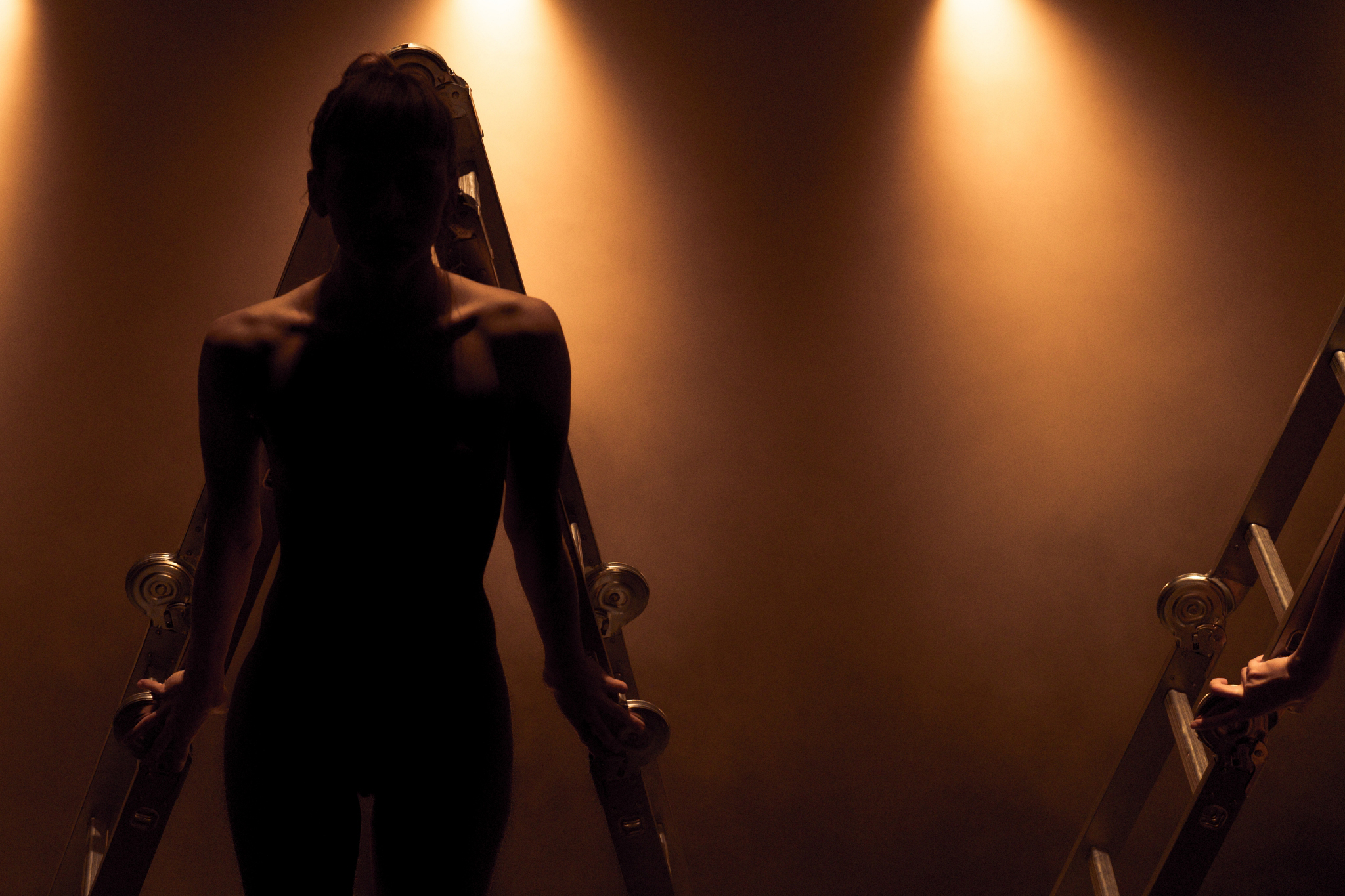
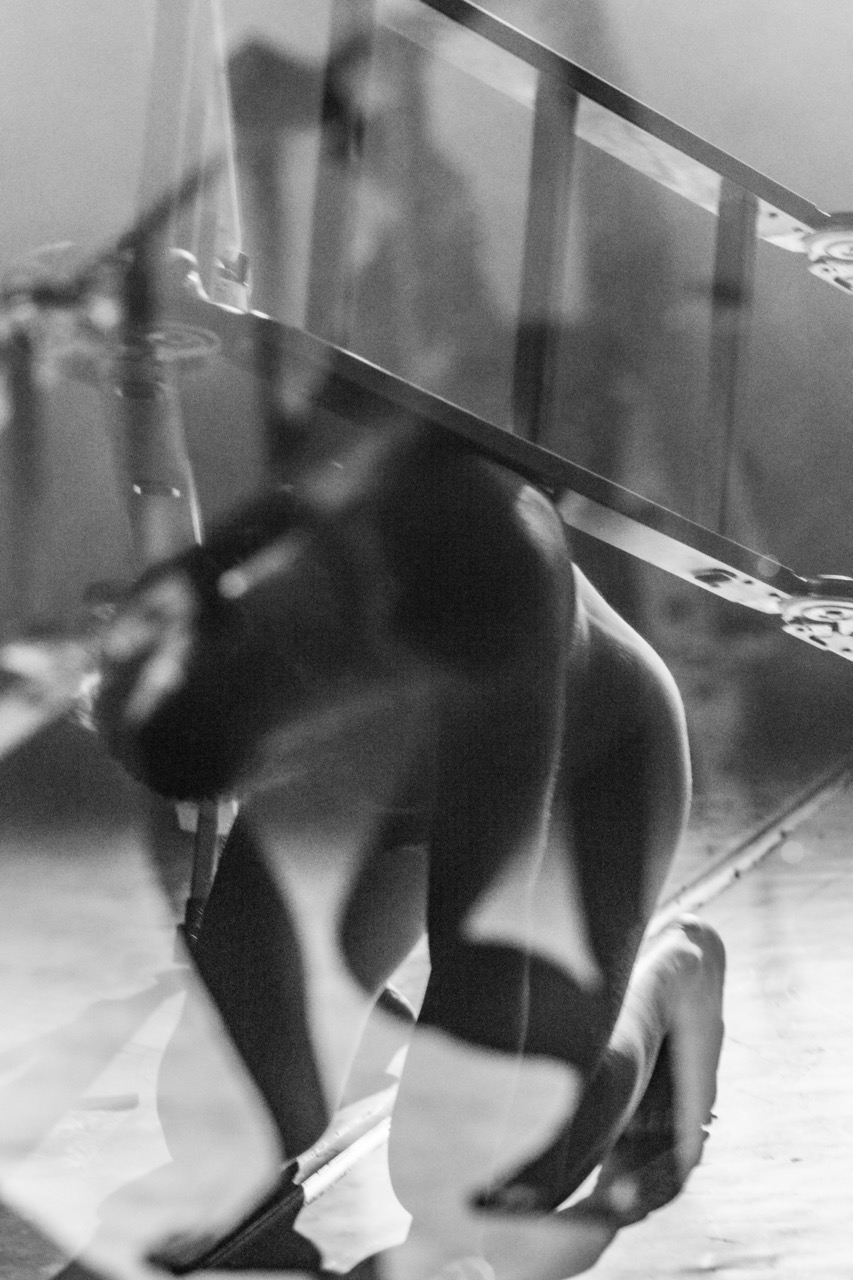
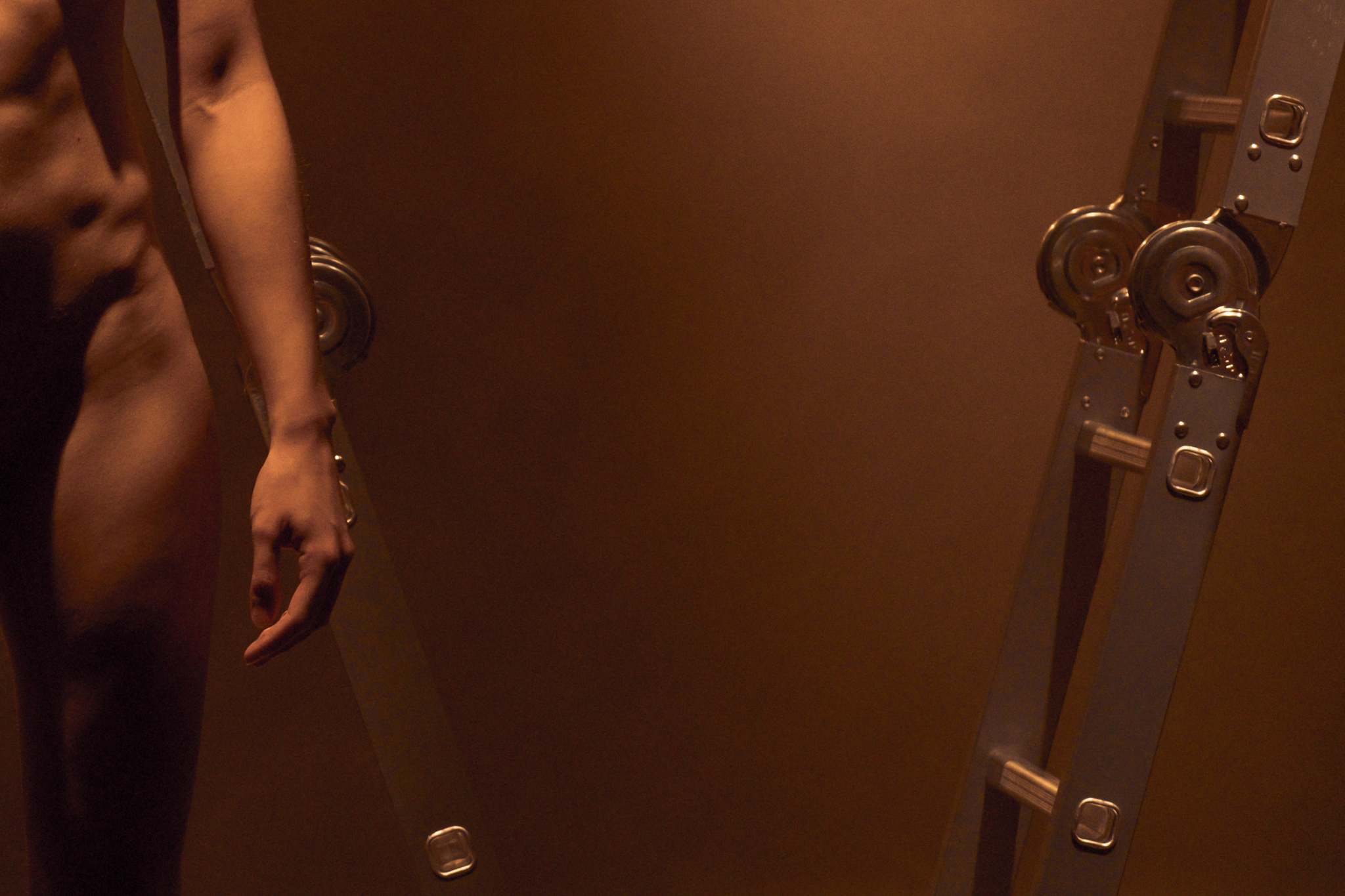
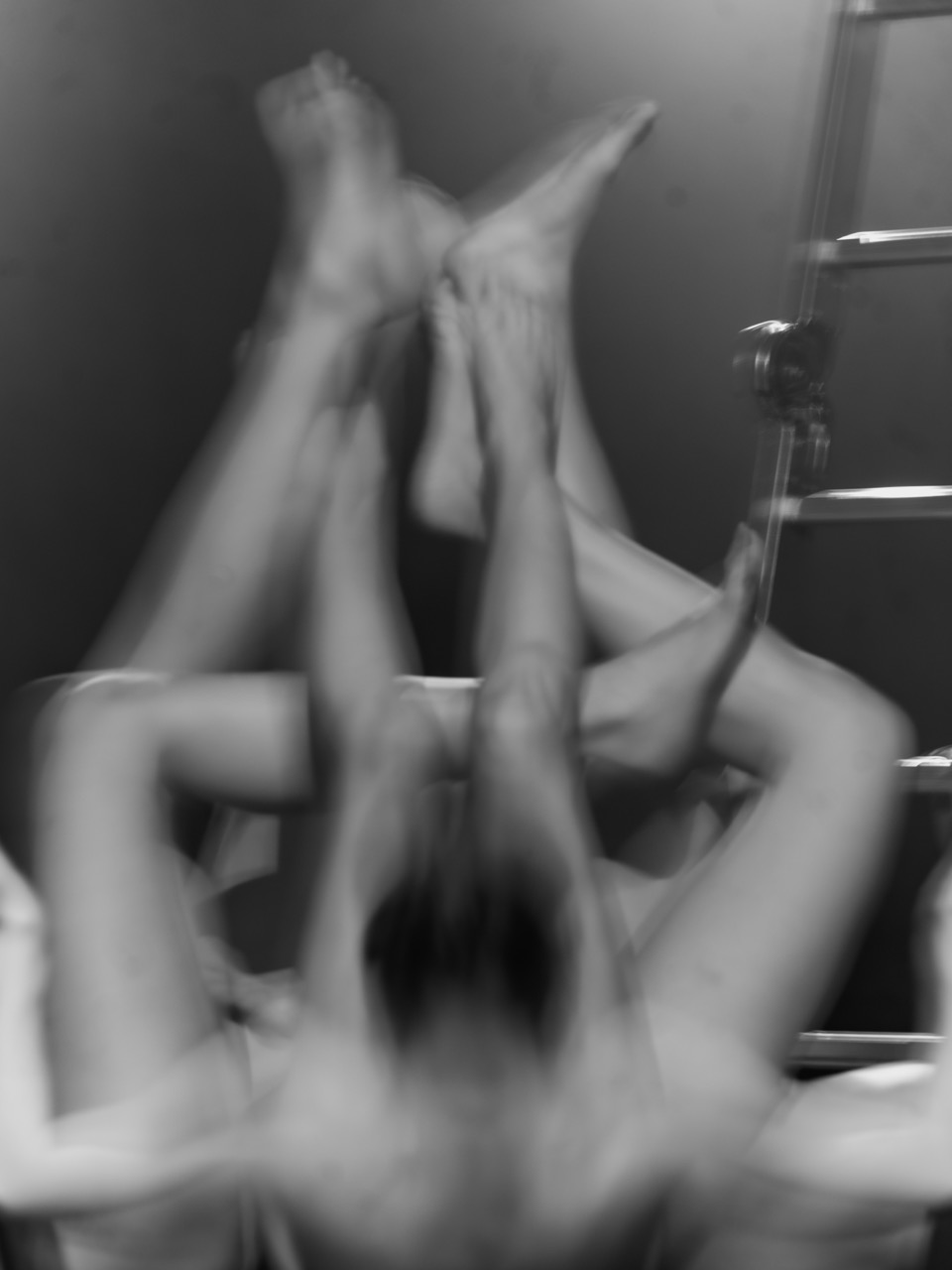
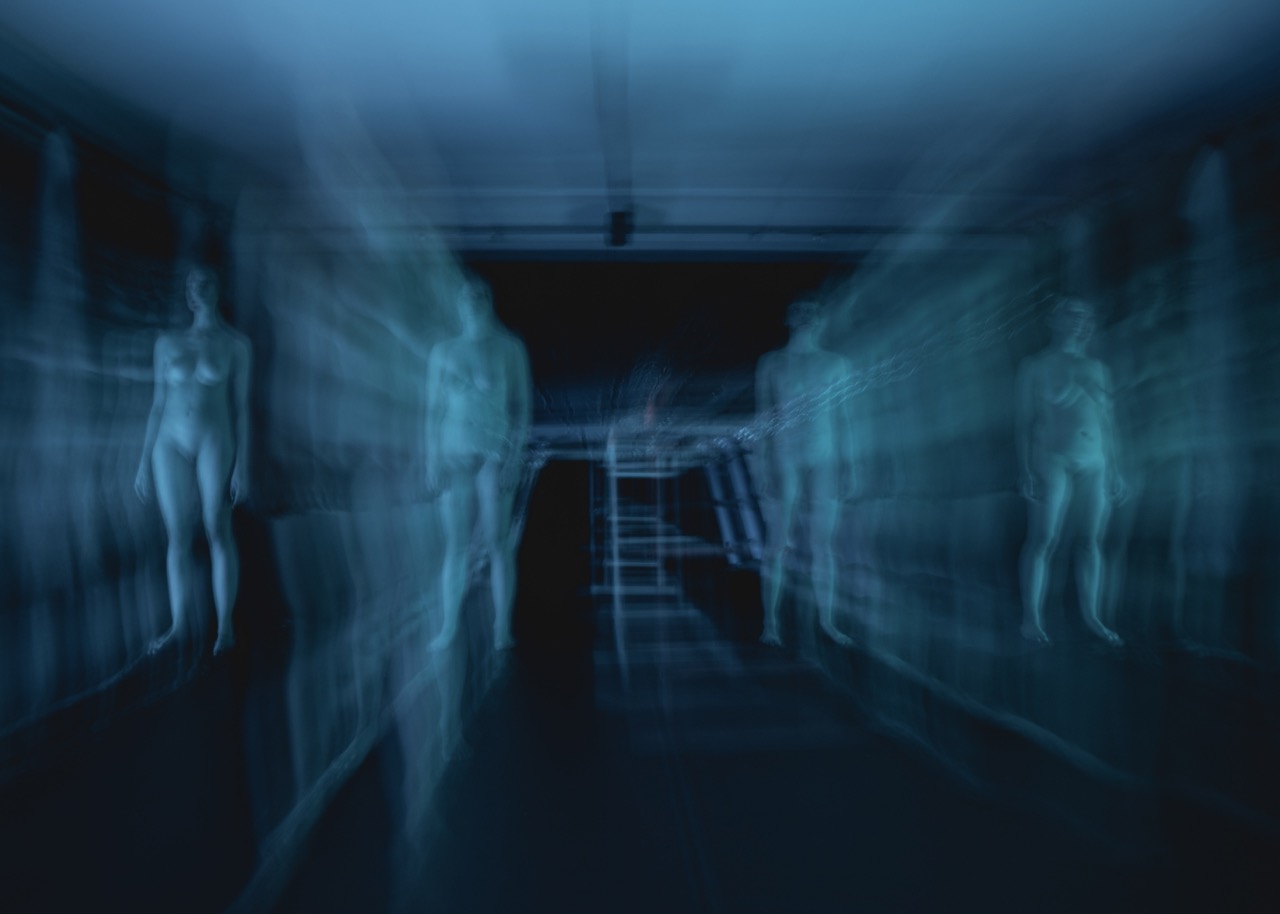
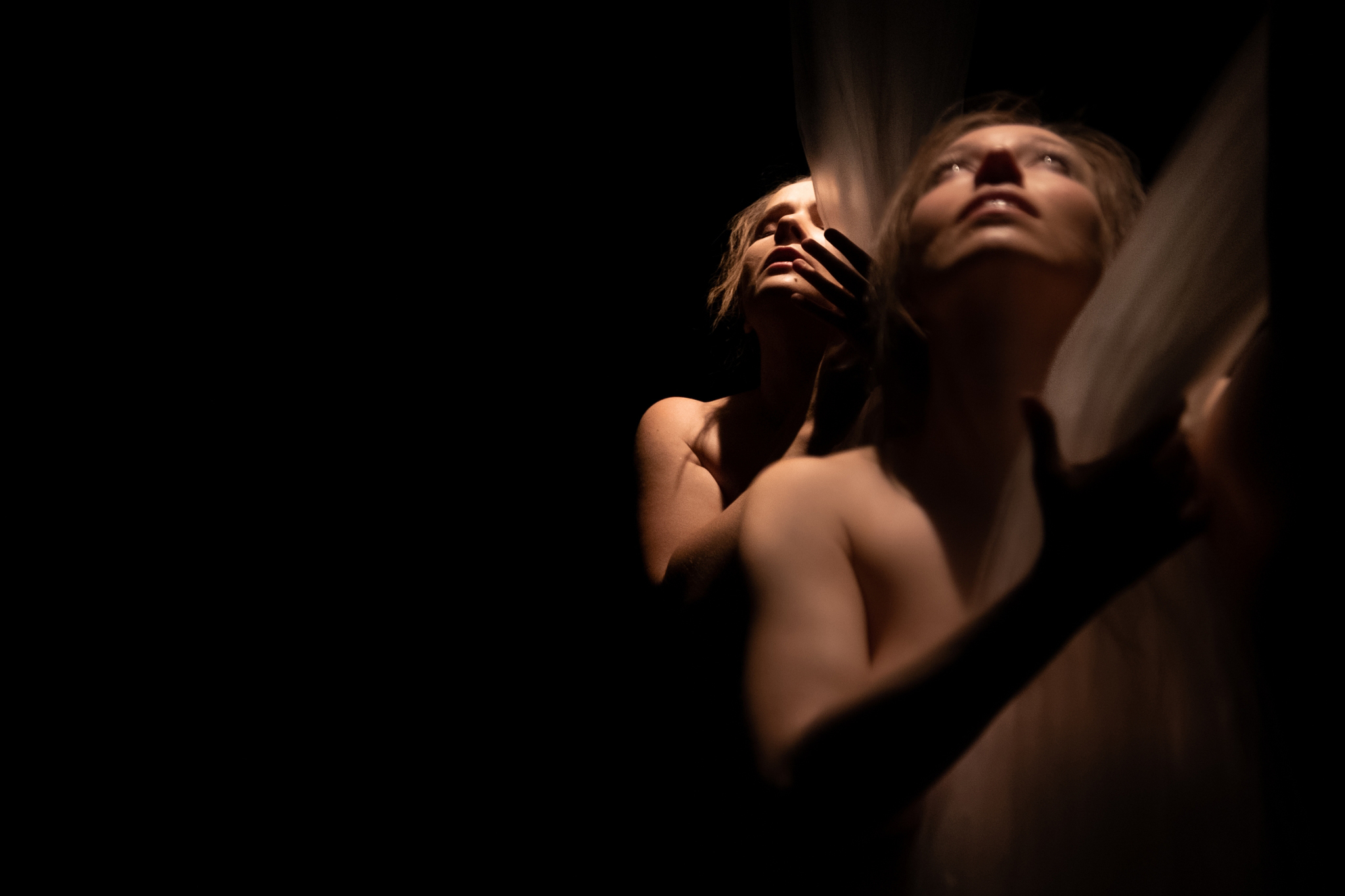
THREE FOUR is a sequence of movement and visual phantasmagoria for four female performers and their bodies, dance, space, sound and light. The theme of the performance is femininity, presented as a combination of what is derived from myths, cultural and imagined with what is contemporary, real and human. “Three Four” is the third part of the “4” series, following the previous performances “Four” (2018) and “Four More” (2021).
Each of the performances of the cycle “4” refers to the meanings and meta-meanings of the number four and the motifs and oppositions associated with it: body-spirituality, heat-coolness, nature-culture, biology-inanimate matter, beauty-ugly, stereotype/truth, feelings/emotions-intellect.
Each performance is an autonomous visual-motor ritual and, at the same time, an existential stage essay on human physicality, fragility and strength, femininity and various understandings of beauty, sexuality and sensuality, transience and mortality. The focus of the creators is the body, its motility and aesthetics, in time and space, in the context of other bodies and in relation to itself, its possibilities and limitations.
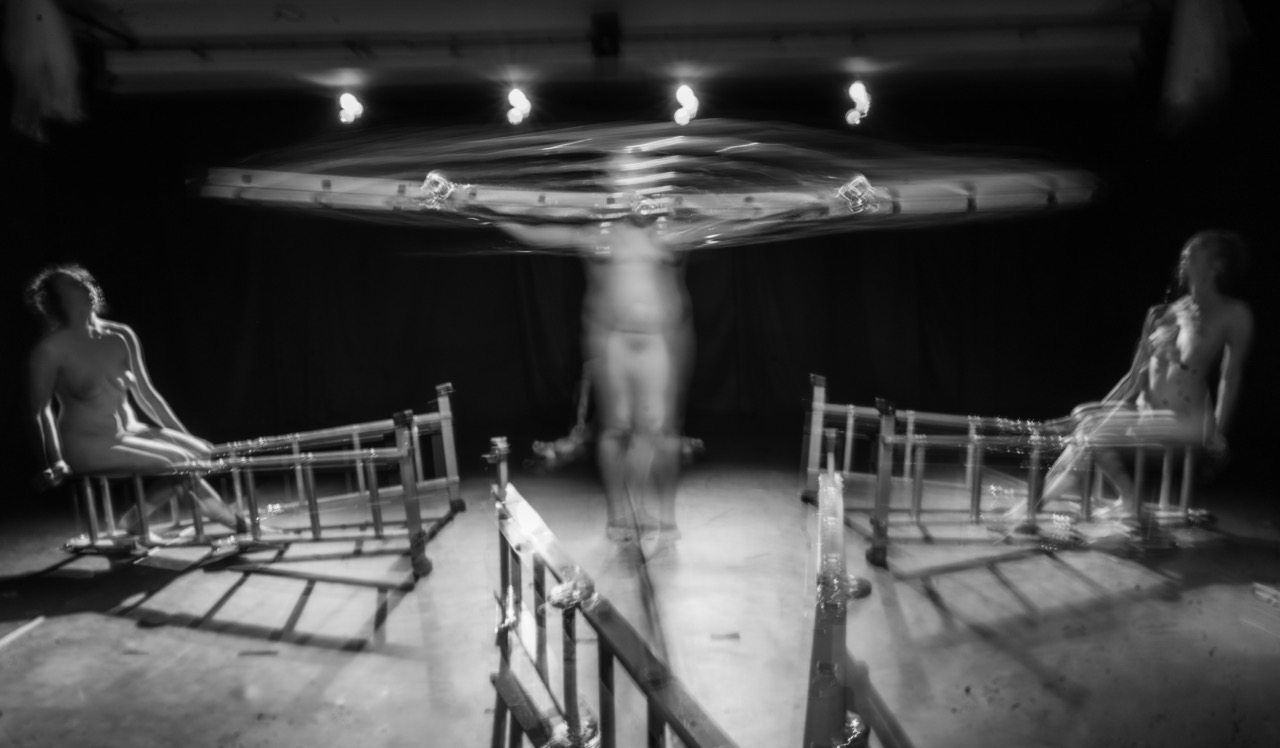
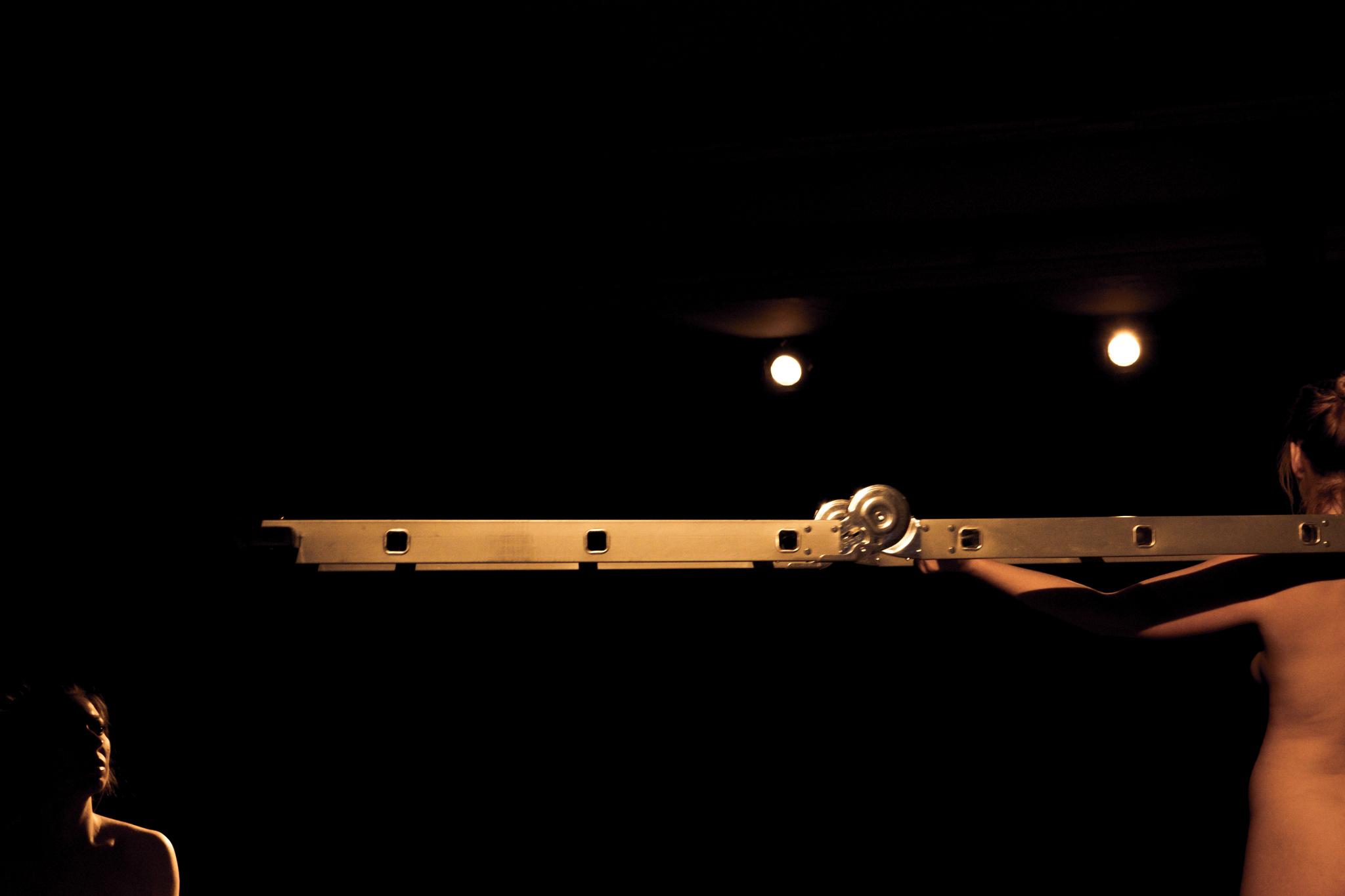
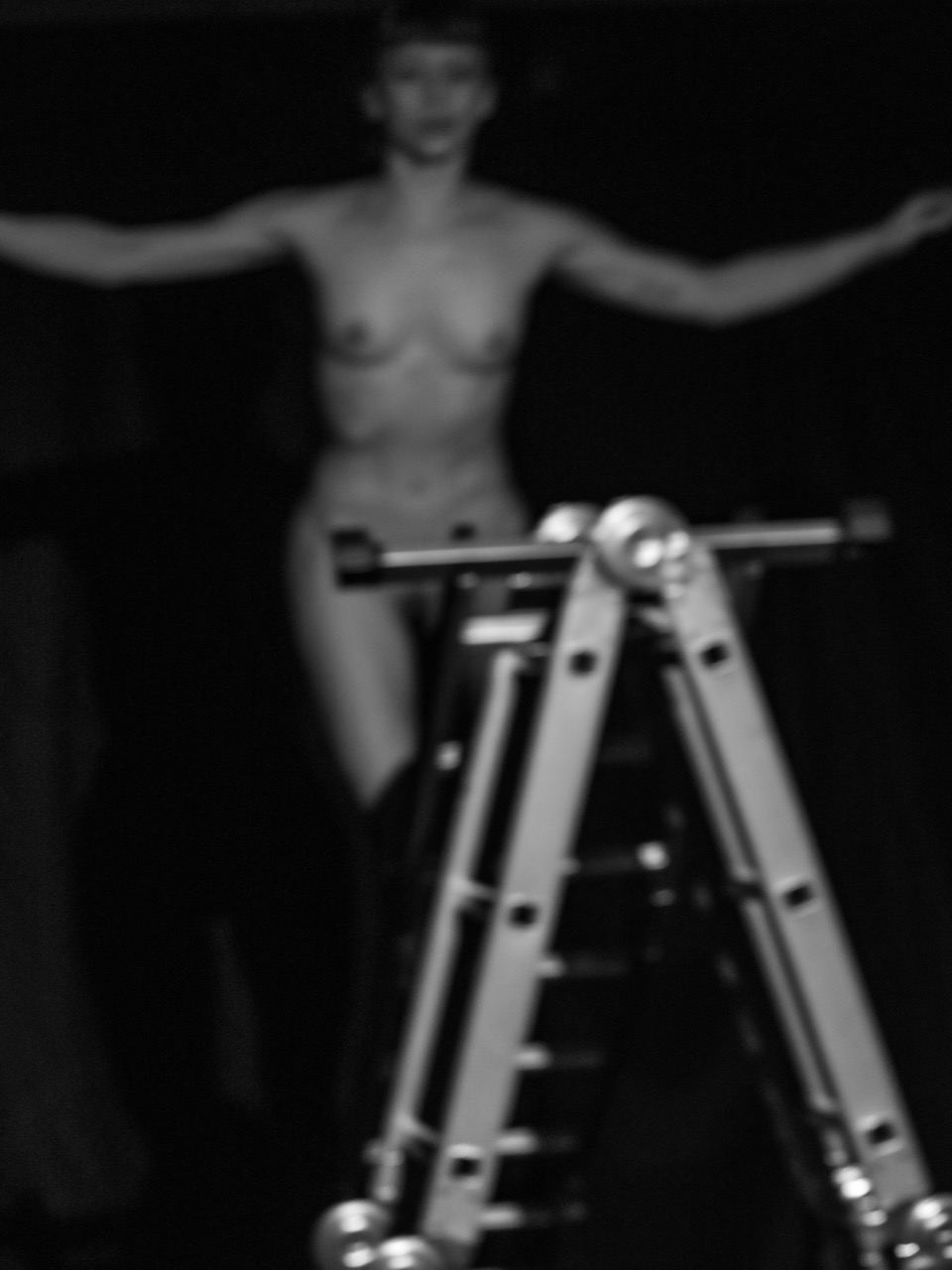
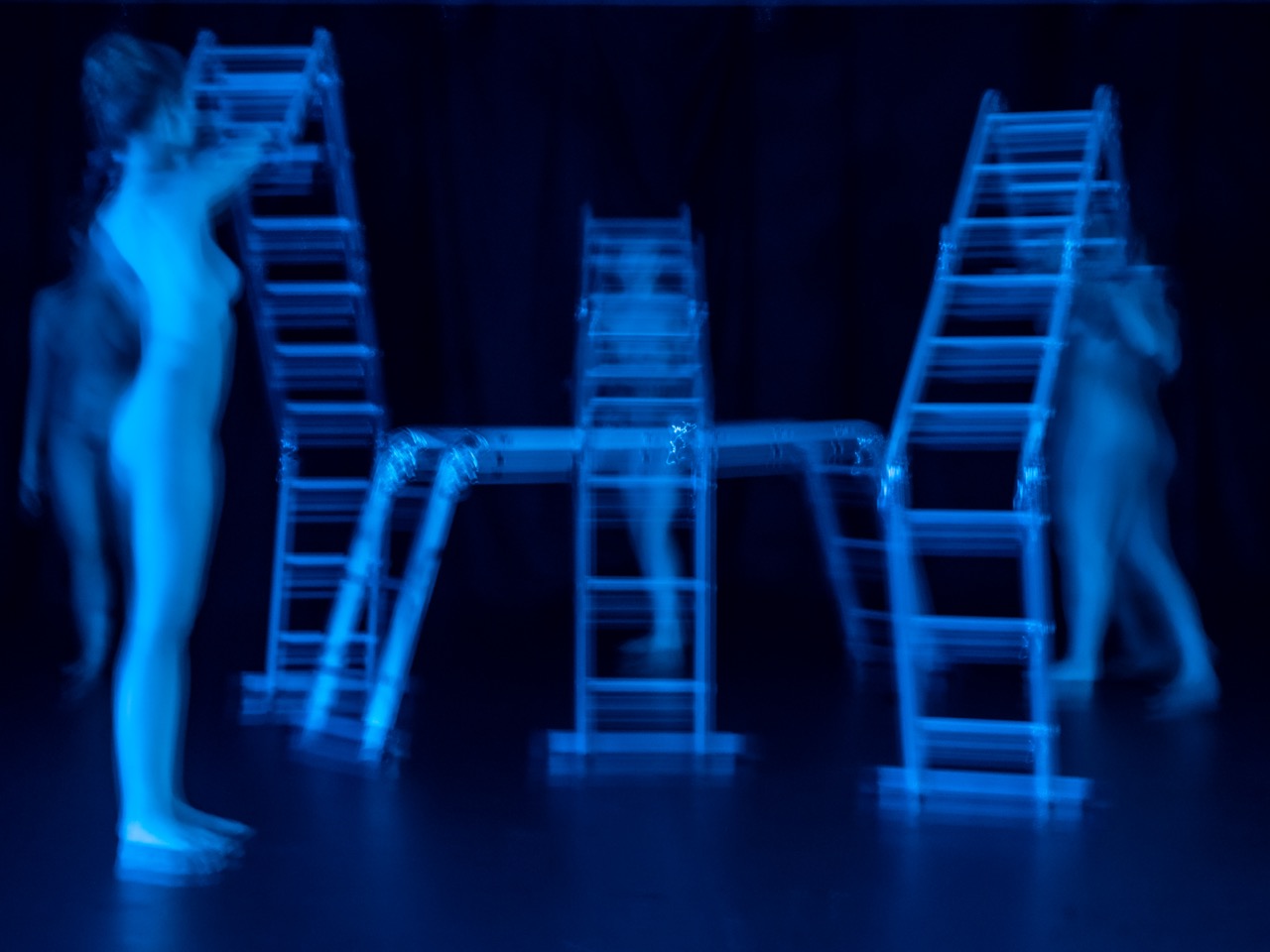
In each performance, the naked bodies of female performers are confronted with metal. In addition to each other, they use metal/steel forms as their partners, which are the main elements of the set design and props. In “Four” it was ventilators/fans, in “Four More” metal sheets, in “Three Four” articulated ladders.
The title of the show “Three Four” does not explain or promise anything. It refers us to the rhythm with which the show throbs at times. “Three-four” is also Polish phrase meaning short, categorical signal to begin, to take off (in English: on the count of three, at the same time). It seems to conceal also anxiety, fear, which is consistent with the emotional layer of the performance. As well as eschatological references, the promise of an end as imminent and violent as the beginning. Title of the performance also refers us to the symbolism of the numbers 3 and 4.
The number 3, according to numerological tradition, is the number of the spirit sphere, that is, that which is derived from matter, from the body, but belongs to the immaterial world, such as emotions and thoughts and their creations, i.e. culture and metaphysics. These, in turn, are perpetuated and objectified by material culture and art. The number 4 is associated with what is material, physical, such as the human body and more broadly, biology, nature, all animate and inanimate matter. In turn, it is directly and indirectly the source of culture and metaphysics. The two spheres, seemingly opposite, interpenetrate and complement each other. Fullness is symbolized by the sum of both numbers, or 7.
These connotations have, of course, a dimension in the performance that is not hermeneutic and intellectual, but aesthetic and emotional, drifting towards abstraction, giving priority to the artistic and emotive side of the theatrical message and composition. Beneath the surface of the form, however, a discreet thread of meaning permeates it.
Fouries
At one stage of our work, the show was to be titled “Fouries”. This did not happen – although we were close to such a decision – for several reasons. First, for fear that without additional context, the title would be misleading and/or mean little. Second, because of doubts that beneath its surface lies an obvious, and no longer noticeable to us, pretentiousness. Thirdly, and above all, due to the fact that the motif of “fury” and “erynia” has been in fashion in culture and pop culture in Poland for some time (including the novel “Les Bienveillantes” by J. Littell and its numerous theatrical adaptations, the play “III Furies” by the Modrzejewska Theatre in Legnica, the Polish TV series “Furies”).
On the other hand, the course of our work, the themes and topics we touched upon and the senses and associations that were revealed in the course of it pushed us towards it intuitively, categorically and inexorably. This is why we share this inspiration here, in a palimpsest, although the performance ultimately bears a title that accompanied us from the beginning and remained so until the end. The traces of this inspiration, however, remained firmly rooted in the material and senses of the performance.
Although the English word “foursies” can be translated simply as “fours,” it is in fact a play on words, a combination of two words and their meanings: “furies” (furies, ancient deities of the earth and underworld, personification of righteous anger) and “four” meaning four.
“Fouries” sounds softer than the Polish “furie” or the English and French “furies,” where the sinister, violent “furies” comes to the fore and most important. And rightly so, for the play is not about rage and its consequences, but about femininity and humanity more broadly as a combination of opposing states, emotions and impulses, also violent, but constituting a complex whole. It is an exemplification of the inseparable union of apparent antinomies: fragility, delicacy, submissiveness, and steadfastness and strength.
The mythological Furies were three in number, and were depicted as tenacious, winged female mastiffs with superhuman qualities. Our Furies are four, and they are humanly beautiful. Their “superheroism” comes not from divine magic, but from their femininity, their divine humanity, their hardship of existence. And also the magic of the theater. Like the mythological Furies, they exist at the interface between the world of spirit and emotion (metaphysics, culture) and the natural world (physical world, nature). At the interface of the earth and the underworld, on the tenuous border between life and death. And although they may seem “gracious” and “benevolent”, because they are also such in essence, after all, a dormant “fury” lurks in each of them.
Furies – in Roman mythology, chthonic deities (female deities of nature, ruling the earthly realm, deities of darkness and death, as well as the earth and its fertility). Demons of the underworld, modeled on similar Etruscan deities. Over time, identified with the Greek goddesses of vengeance, the Erynias.
For: Wikipedia
Erynias – in Greek mythology, goddesses and personifications of vengeance (punishment, wrath) for all iniquity. They were born from the fallen blood of the castrated Uranos (heaven) on Gaia (earth). They inhabited Ereb (the darkness of the underworld). The ancients avoided the word “erin,” for fear of evoking them. So they were called “Venerables” (Semnaj), and “Curses” (Araj). They personified remorse after breaking a taboo. After Athena pardoned Orestes pursued by Eryne for matricide and they ceased their pursuit, they were also called “Gracious” (Eumenides).
For: Wikipedia
————————————————————————————————————————————————–
created and directed by Marcin Herich
choreographic cooperation: a team
performed by Alina Bachara, Zuzanna Łapka, Krystyna Szymura (Marta Zielonka), Karolina Wosz
music: Barbara Strozzi, Fetisch Park, Gas, Kato Hideki, Mr. Geoffrey & JD Franzke, Paul Schütze, Social Interiors
duration of the performance: 45 minutes
————————————————————————————————————————————————–
PRESENTATIONS
- 17, 18, 19 February 2023, Stage/Atelier of Teatr A Part, Katowice (premiere)
- 22, 23 June 2023, Stage/Atelier of Teatr A Part, Katowice, International Performing Arts Festival A Part
- 3 September 2023, Stage/Atelier of Teatr A Part, Katowice
- 8 October 2023, Stage/Atelier of Teatr A Part, Katowice
- 29 October 2023, Stage/Atelier of Teatr A Part, Katowice
- 11 November 2023, Stage/Atelier of Teatr A Part, Katowice
- 2 March 2024, Stage/Atelier of Teatr A Part, Katowice
- 23 November 2024, Centre for the Documentation of the Art of Tadeusz Kantor Cricoteca, Kraków, Perform(ing) Poland
- 11 December 2024, Stage/Atelier of Teatr A Part, Katowice
- 12 January 2025, Stage/Atelier of Teatr A Part, Katowice
- 19 October 2025, Stage/Atelier of Teatr A Part, Katowice
CRITICS
Illusions, boundaries, participation
‘Three Four’ – the third part of a stage work conceived for a quadriptych. In 2018, A Part, together with Teatr Amareya, produced ‘Four’, two years ago he added ‘Four More’. Both performances referred to symbols, iconography, the meaning of numbers (in European, Semitic or Asian culture), explored ancient and contemporary threads, but above all told stories of the body and femininity. ‘Four More’ and ‘Three Four’ are wordless sequences of compositions that follow each other like slides (the stories of bodies run non-linearly, but time is of course of great importance, because we see bodies in time). A huge clock – an installation composed of a ladder and a female body, made of solid and fragile matter, slows down and speeds up, we set off on a short scenic journey through 2,000 years of civilization, from antiquity, its images and myths through the 50s and 60s (including their iconography – post-war prosperity in the shadow of fears of nuclear holocaust) to the present, its rhythms and symbols (capitalism and its illusions of freedom). Herich invented a multi-functional prop (a ladder), conceived both as a (emancipatory) metaphor and as a tool thanks to which he can change forms and configurations, create a specific stage design in a minimalist way. The number of metamorphoses/transformations is of course limited, but ‘Three Four’ was not about using them all. An additional advantage of this idea was the contrast obtained thanks to it. Cold steel and body heat. Durability and hardness as well as softness and brittleness, a contrast also at the gender level. After all, the ladder belongs to the male world rather than the female one. In the play by Teatr A Part, the operator is only a woman. And it is the woman who processes the world with her help.
Radek Kobierski, www.miasto-ogrodow.eu, 07.2023
Pleasure and anguish
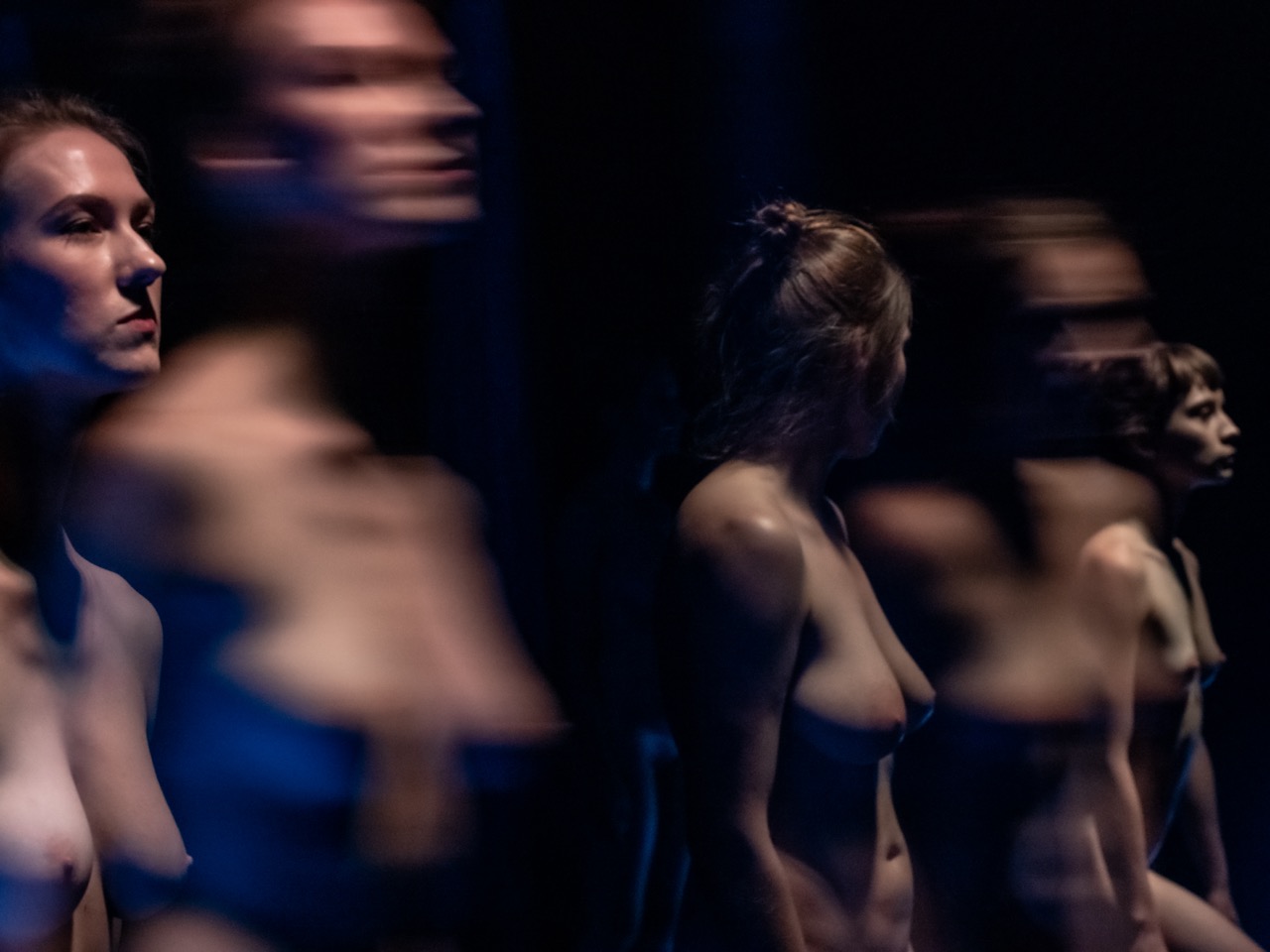
By far the most aesthetically pleasing – in the classical sense of the word – event of the festival was the physical and visual performance ‘Three Four’, directed by Marcin Herich, which is a study of femininity – its delicacy and strength, passivity and activity, corporeality and spirituality. During the performance, four naked actresses (Alina Bachara, Zuzanna Łapka, Karolina Wosz, Marta Zielonka) performed a complicated choreography on ladders, in shower cubicles or simply on the floor. Although their types of beauty and silhouettes differed, they all fitted into the contemporary canon of beauty, and watching their bodies – combined with the play of light and shadow and the music – move in an ever-changing dynamic, made us think of physicality and especially sexuality with delight and longing.
Weronika Górska, www.miasto-ogrodow.eu, 07.2023
The drive of life, the drive of death
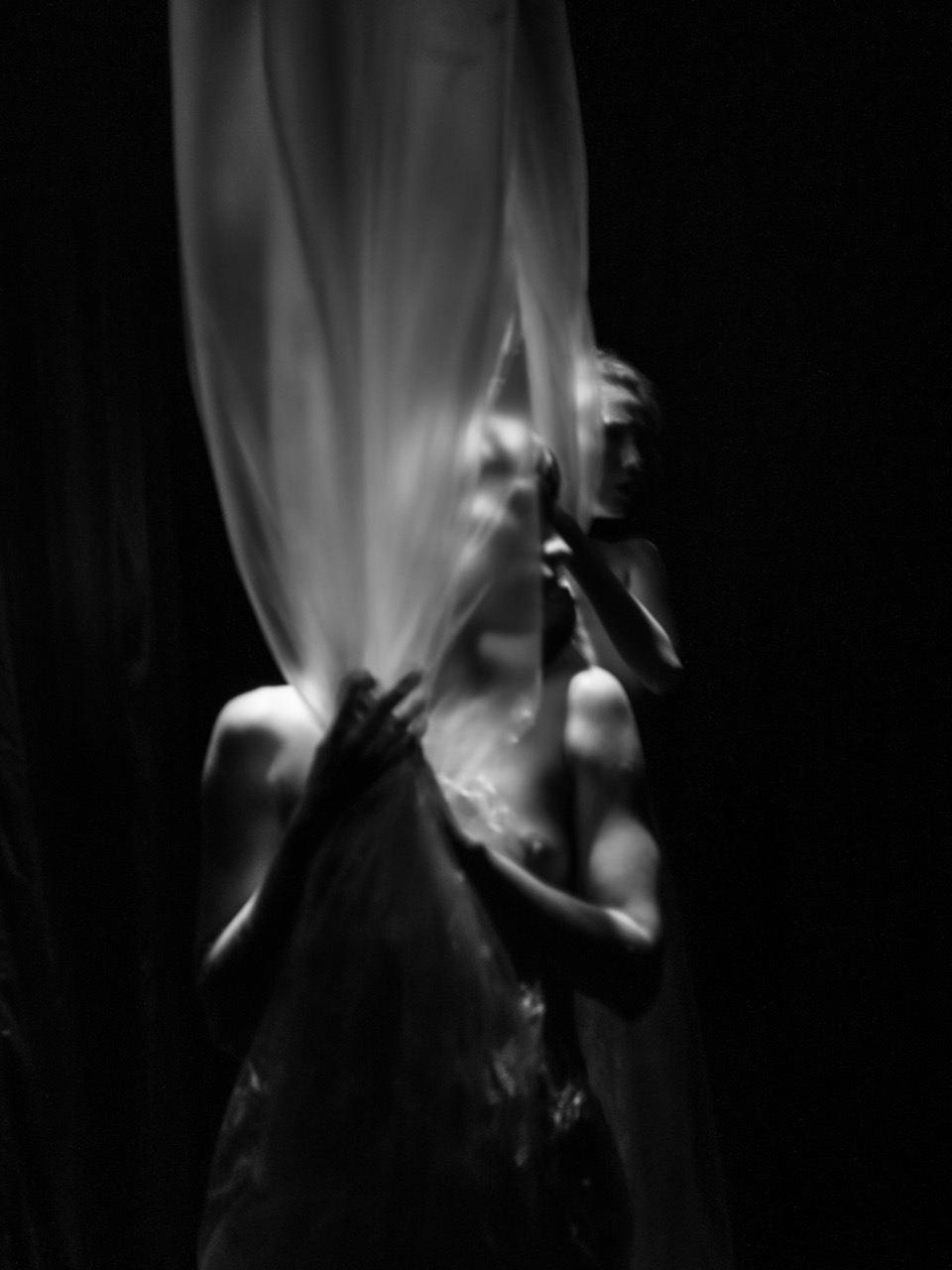
The play ‘Three Four’ is written in an ambiguous language. There are no words, no set design (apart from props-objects and light), and no explicit suggestions. It is a performance of great rawness – the materials present are: naked bodies, ladders, foil. And nothing else.
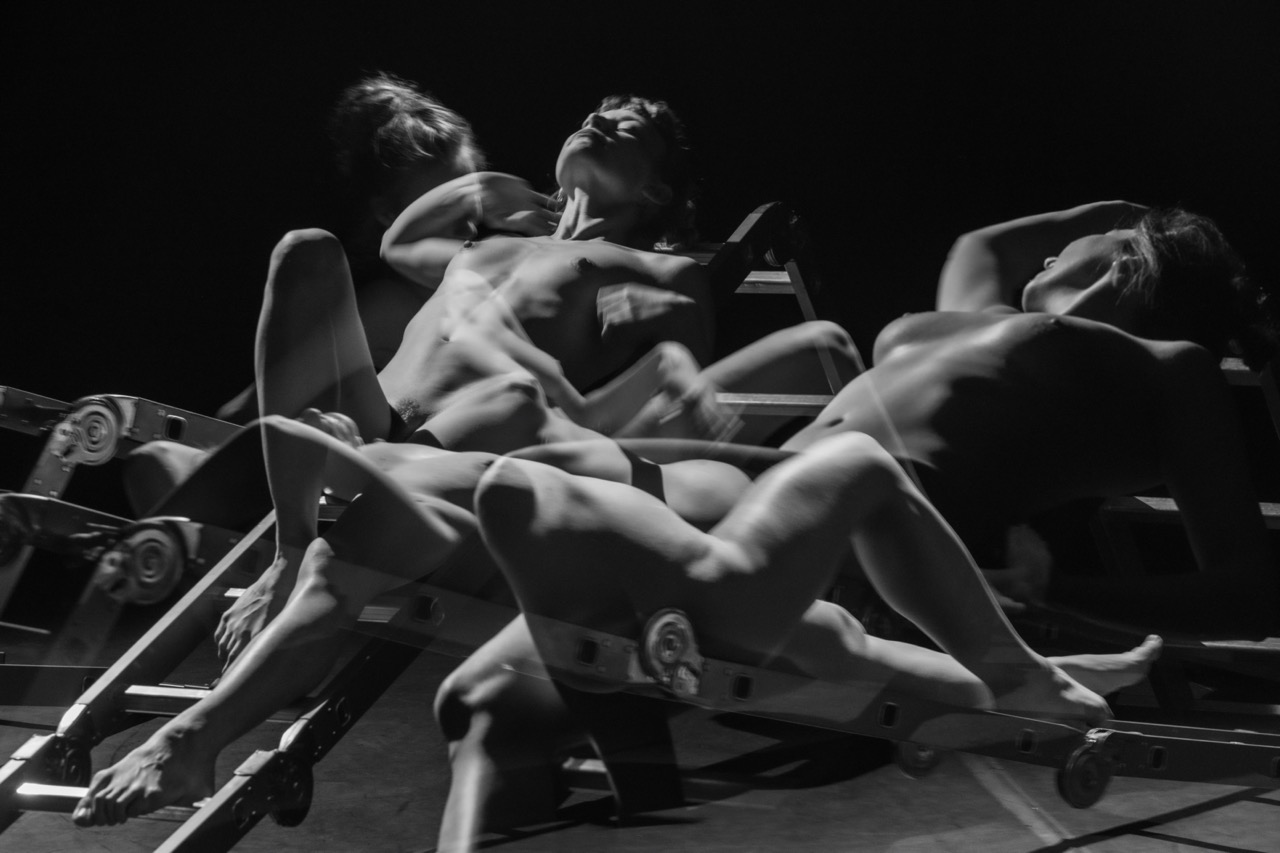
Four naked female bodies, largely in rhythmic reciprocal movements, performed a performative act consisting of movements, gestures, figures (intertwining each other). For most of the act, they acted in front of ladders (there were also four of them) made of steel, heavy and seemingly also naked.
The field for interpretation becomes very much the matter itself: flesh, metal, foil, and what the living matter presented through them and how they positioned the inanimate ones in relation to each other. The entire atmosphere of the performance, from the aspects I mentioned earlier, through the emptiness in which the human being – woman x 4 finds herself, to the fact that the ladders used by the performers were made of steel and really heavy (which makes it a performance leaning heavily towards performance art), has existential overtones. And hence my first association: the biophilia-necrophilia antagonism.
“Three Four” is about antagonism, which starts with the meaning of the title itself, but is also very evident in the performance itself. The performers’ bodies seem to create a single mass, often broken up by the metal of the ladders. Bodies and ladders form different configurations and symmetrical arrangements that, even when seen from the side, I had the feeling that from above they probably look like changing images in a kaleidoscope. This, in turn, exacerbates the feeling of a jumble between matter that will never merge, even when taking part in one common image – they will never fit together. The kaleidoscopic nature of the images, on the other hand, is for me something indicative of the passage of time, in which the systems of forces and their gravities change.
To return to my association: biophilia is the drive of life, while necrophilia is the drive of death. These terms were introduced by Erich Fromm. The body naturally represents the first concept – and for most of the play I would intensely associate it with this drive; the ladder, as the second major player, represents necrophilia. These concepts are as naked and basic as their symbols.
On the other hand, I also think of the body as something very primordial, in contrast to the ladder, which could be an outgrowth of human culture, a symbol of what we are capable of producing, and thus, since it is so important and even fetishised – it could represent necrophilia. Necrophilia is a favourite in what did not necessarily have to become dead in the process of transformation from the living, but also in the inanimate – following Fromm.
Furthermore, it is difficult not to look through gender, as it is certainly not insignificant that the performers were chosen in this way and not in any other way, and these are four women. And since I turn my thinking to the tracks of such raw concepts, existential but at the same time possessing a disjointed poetics, I would lean towards what femininity in culture is in a universal sense, not so much embedded in specific times. And femininity in both European and Eastern culture has long been associated with dark power, subconsciousness (intuitive actions), passivity. The opposite is masculinity – bright, active, conscious.
Through such connotations, I perceive ‘Three Four’ as a performance about a dark, mystical, primordial space that seeks to entwine a mechanical, modern, dead force. The emotion of releasing, entwining, being, does not seem at all easy.
“Three Four” is, for me, a performance beyond time – as if it merely bounces about the times at certain points and levitates onwards, merging them together into one big time. As a result, its poetics resonate with distant echoes.
Klaudia Brzezińska, ‘Dziennik Teatralny’, 10.2023
Photos: Maciej Dziaczko, Grzegorz Krzysztofik
open gallery view video