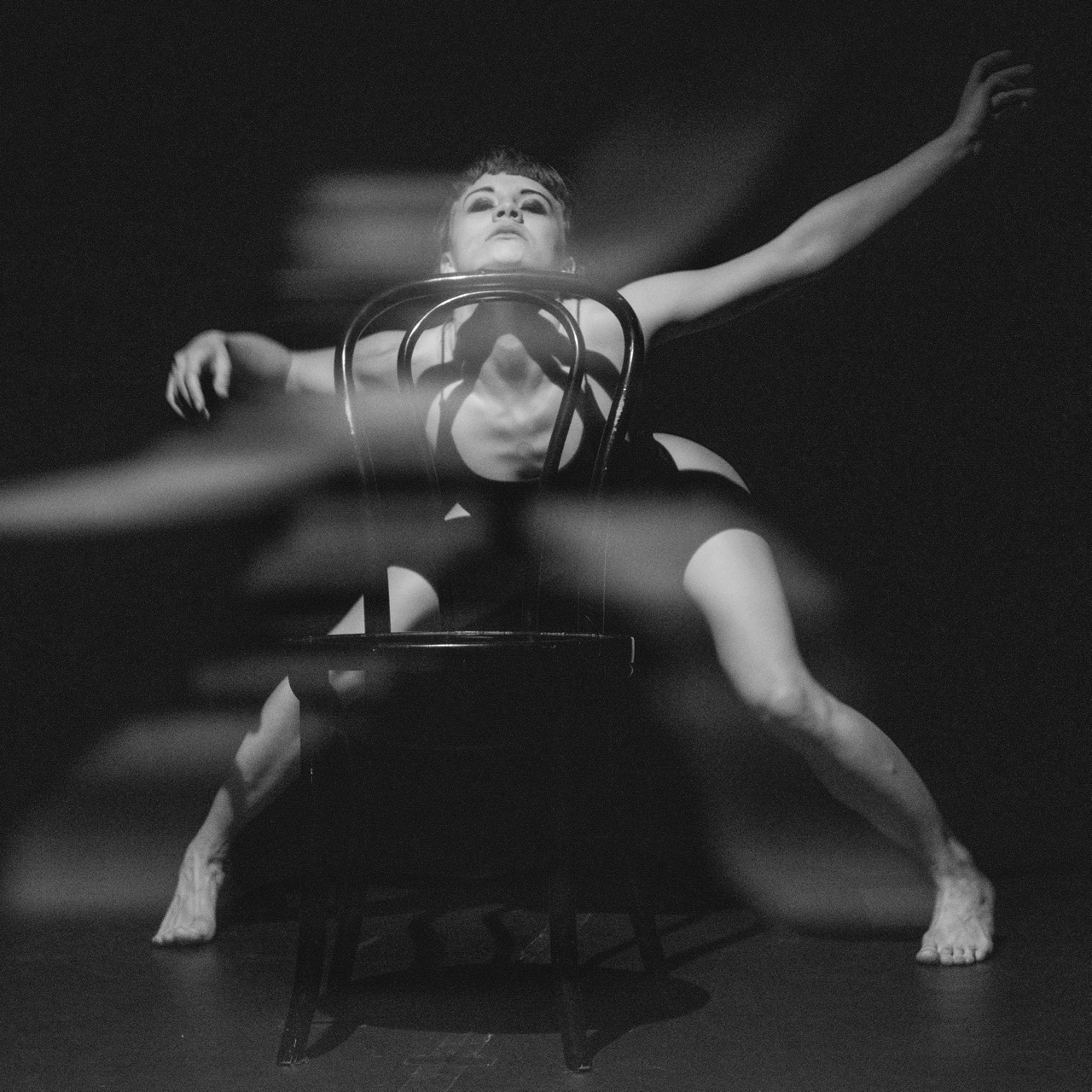
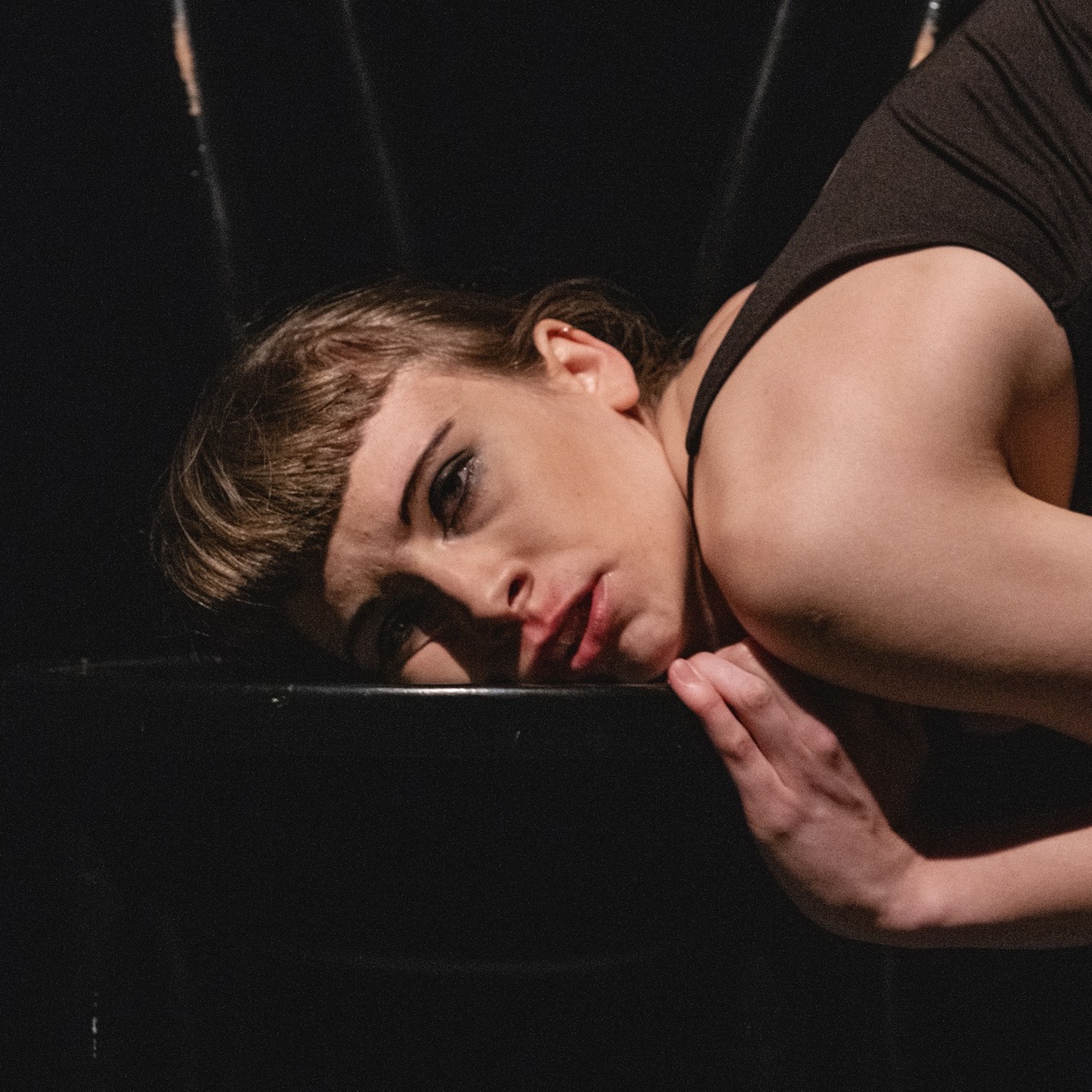
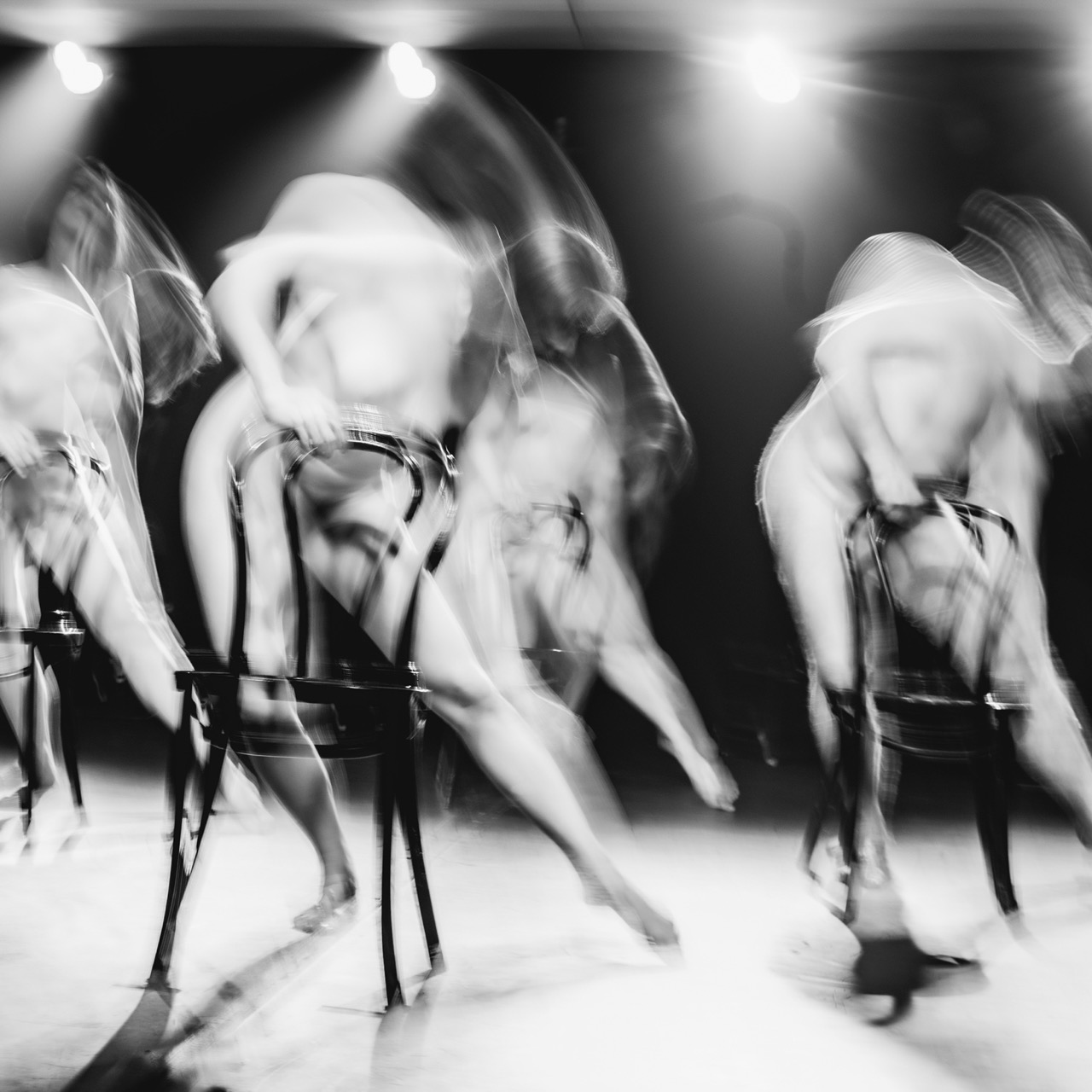
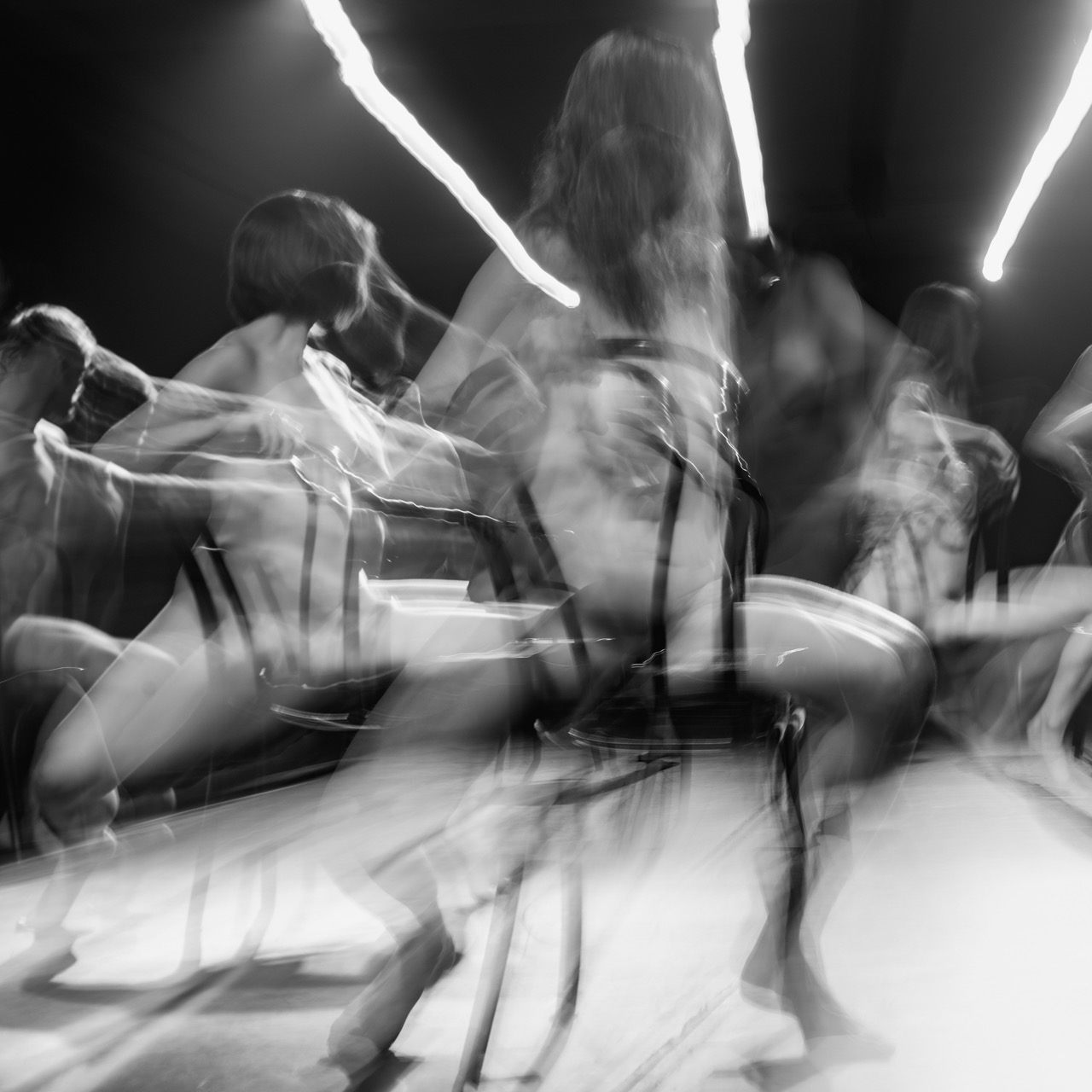
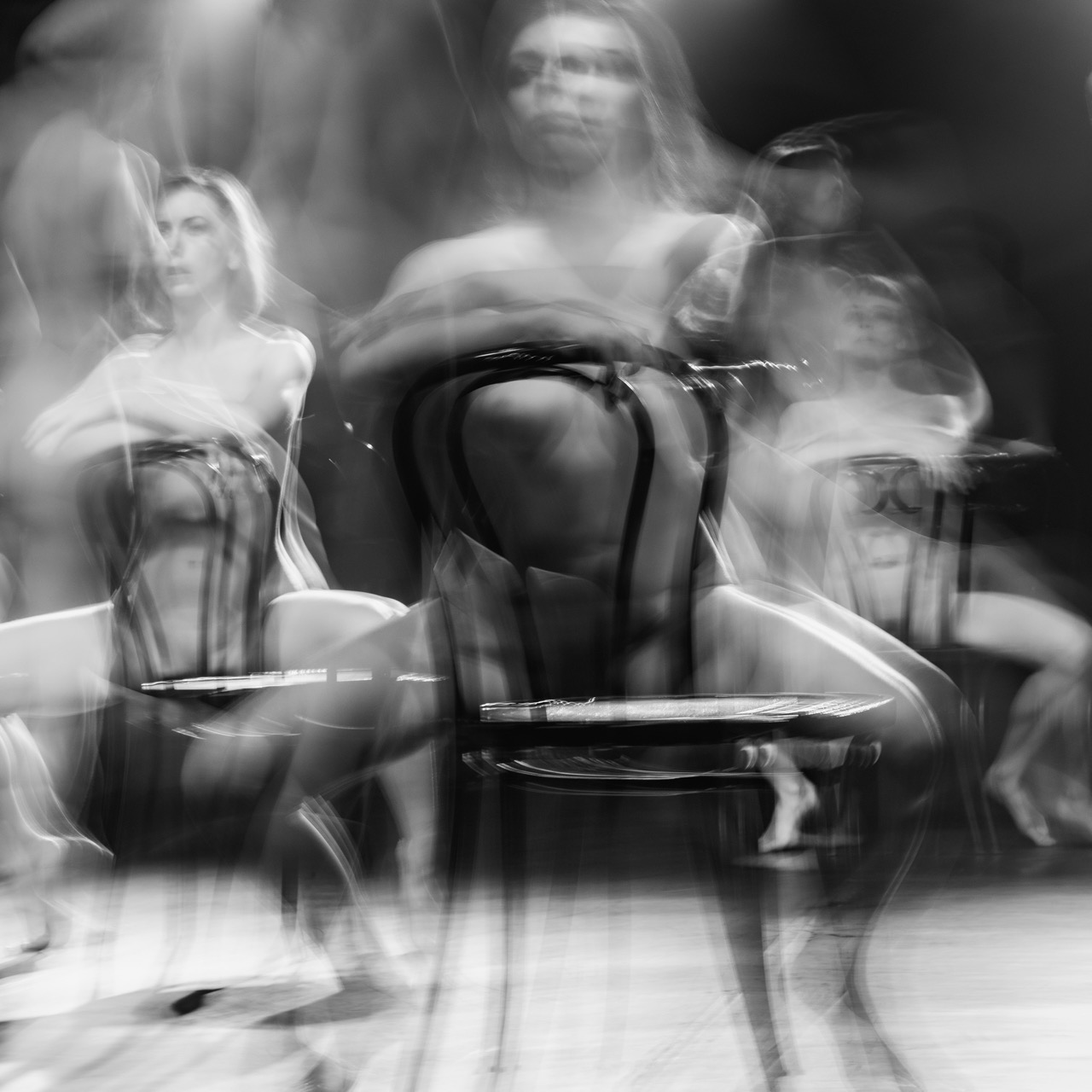
The performance titled I DIED OF HAPPINESS is another in the series of performances by Teatr A Part, inspired by the history and spirit of the place where Marcin Herich and his team work in Katowice, as well as the aesthetics and convention of artistic cabaret of the first half of the 20th century. In the current seat of the Teatr A Part, in the years 1907-1915 one of the first silent cinemas in Katowice operated, and in the years 1940-1944 the German cabaret Künstlerspiele operated.
Apart from a few photos of the cabaret’s interior, which survived on postcards and information about performance hours in the German press, no other traces of that variety have survived. We know nothing about the program and the nature of the shows taking place there. However, the knowledge about this type of performances in other cities of Europe at that time and the persistent presence of Zeitgeist means that in subsequent performances of the guasi-cabaret cycle, which constitutes a separate trend in the work of A Part, we perform a kind of spiritualist archeology and fictitiously reconstruct the cabaret ‘numbers’ of our artistic ancestors, mixing them with modernity and the style of Teatr A Part’s performances.
The stylistic and ideological closeness of the artistic cabaret of the beginning of the century and the interwar period, especially the Weimar Republic, Zurich and Paris, to our artistic endeavors (existential themes, fatalism and a sense of decadence, moral disinvolence, references to other fields of art, especially visual arts, interest in history) makes us we feel exceptionally good and at home in such a mixture.
So far, three mainstream performances have been created: ‘Künstlerspiele. Scenes from the Great War’ (2014), ‘In the jungle of history. Variete’ (2015) and ‘The Last Days of Mankind”‘ based on poem by Karl Kraus (2018), the music to which was written by Brecht’s famous musical cabaret The Tiger Lillies.
The fourth quasi-cabaret performance of Teatr A Part titled ‘I Died of Happiness’ pushes the topic of war, the main thread appearing in previous performances of the trend, into the background, focusing more on artistic, existential and moral motifs, also due to the unusual fate of the protagonist of the play. Anita Barber (1899-1928), silent cinema star, as well as an uncompromising scandal artist and one of the most important theater and dance innovators of her time – an icon of the Weimar Republic era.
The play is not a biography of Berber, although at the initial stage of work we used the title ‘The Life and Death of Anita Berber’, which ultimately became the title of the first scene of the play. The words “life and death” that appear there refer to two warring elements, intertwining with mad intensity in the fate of artists of that era, balancing on the edge like artists from the era of flower children and cursed poets fifty years later. Anita Berber and her fate are one of the most vivid manifestations of ‘life as a work of art’ – one of the ideals of the avant-garde.
Anita Berber is known today primarily as the ‘naked dancer’. Her work, although also manifested through stage nudity, concerned the hardships and darkness of existence. Berber said: ‘I dance death, disease, miscarriage, syphilis, madness, dying, infirmity, suicide.’ Out of this tension, a new, disturbing, true art was born. From the perspective of contemporary art, it can be said that Berber was and is the forerunner and one of the godmothers of contemporary performance.
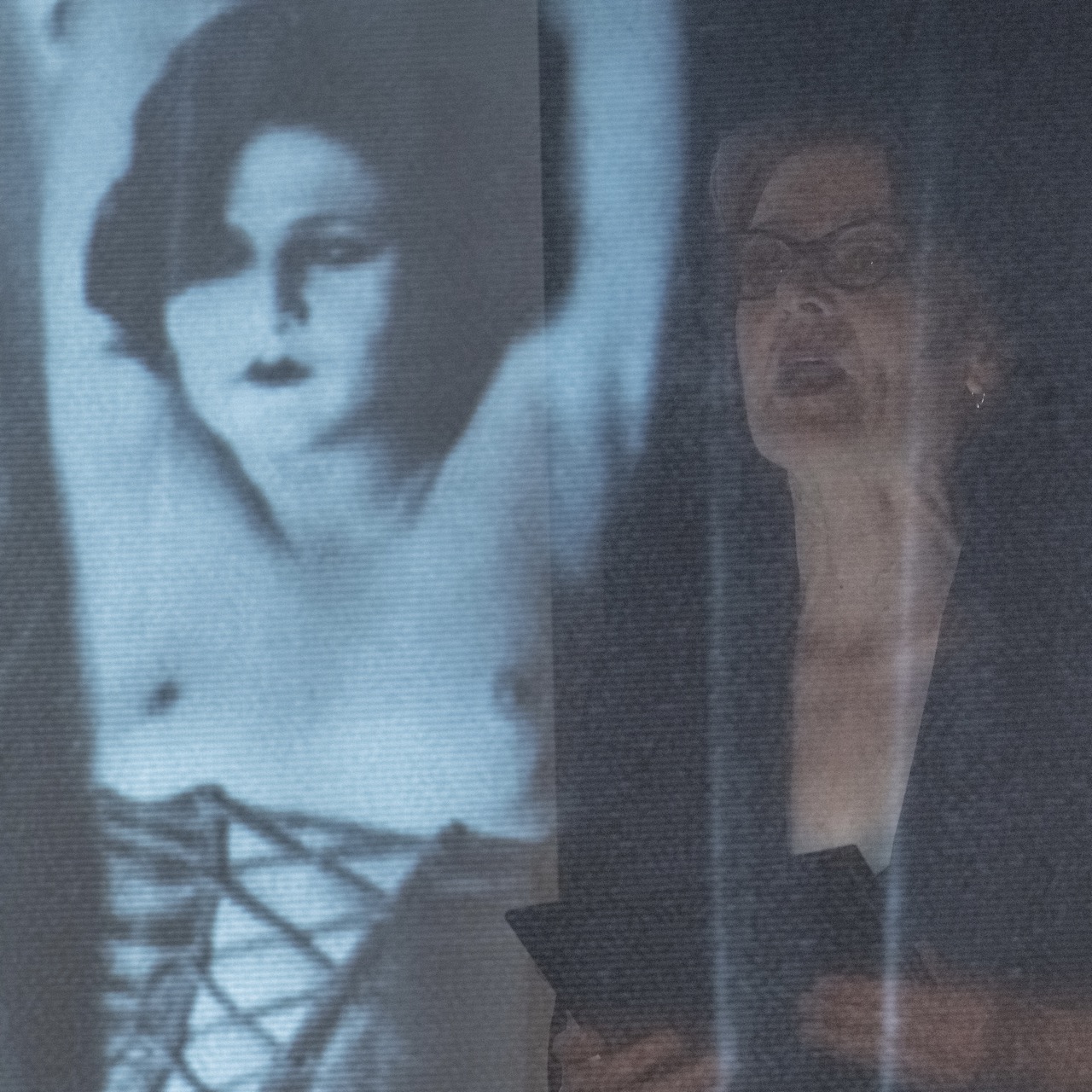
Taking into account preserved fragments of films, photos and descriptions of Berber’s performances, selected threads from her biography and texts written by her as well as interview texts, in a new ‘cabaret’ performance we reconstruct and translate these motifs, weaving them into a kind of theatrical freak show bordering on a lecture. , theater, revue, performance and cabaret. Solo performances or duets known from Berber’s work, such as ‘Morphine’, ‘Cocaine’, ‘Suicide’, ‘Salome’, are reconstructed and deconstructed in a new, contemporary cultural context.
The direct driving force behind the production of the performance was the exhibition ‘The Witch’s Cradle’, presented during the Biennale Arte – La Biennale di Venezia 2022, rediscovering the achievements of the female artists we met and thus restoring their rightful place. Even though Anita Barber was missing from the exhibition, or maybe because of it, we bring her back from the depths of time and remind her.
I Died of Happiness. Revue
Program of the evening
1. The life and death of Anita Berber
2. Memento mori
3. Ghosts among us
4. ‘Salome’ (reconstruction)
5. Kinematograph
6. ‘Cocaine’ (reconstruction)
7. Welcome home, Janis
8. ‘Suicid'” (reconstruction)
9. You damn pigs!
10. Anita-Berber-Park
11. ‘Morphine’ (reconstruction)
12. Modenschau part I
13. Blue Angel
14. Modenschau part II
15. Life is a cabaret
Script, direction, choreography, lighting: Marcin Herich
Collaboration on costume design and choreography: ensemble
Collaboration on space design and set design: Cezary Kruszyna
Development and text of lecture and text of monologue (inspired by the writings of Francis Picabia and Leopold Wolfgang Rochowanski): Natalia Kruszyna
Concept and construction of instruments: Tomasz Manderla
Solo flute part: Krystyna Szymura
Performers: Alina Bachara, Daniel Dyniszuk, Katarzyna Gogacz, Grzegorz Król, Cezary Kruszyna, Natalia Kruszyna, Zuzanna Łapka, Krystyna Szymura, Karolina Wosz
Music: Frederic Chopin, Ludwig van Beethoven, Jeremy Healy, Friedrich Hollaender, Janis Joplin, Camille Saint-Saëns, Ryūichi Sakamoto, Mischa Spoliansky, The Art of Noise
The performance uses an excerpt from the song ‘Ich bin von Kopf bis Fuß auf Liebe eingestellt’ by Marlene Dietrich, translated by Agnieszka Kreczmar, from the movie ‘Blue Angel’.
The performance uses an excerpt from an interview given by Janis Joplin on the occasion of a concert in Frankfurt, Germany in 1969.
The premiere of the performance took place on 2 May 2024 as part of the [RE]zydencje competition during the PESTKA Festival of Avant-garde Theatre and Culture at the Teatr im. Cypriana Kamila Norwida in Jelenia Góra.
The performance was nominated for the Golden Mask 2025 award in the ‘special award’ category for ‘nudity that is a costume’.
Duration: 75 minutes.
PRESENTATIONS
- 26 April 2024, Stage/Atelier of Teatr A Part, Katowice (closed preview)
- 2 May 2024, Teatr im. Cypriana Kamila Norwida, Jelenia Góra (Festival of Avant-garde Theatre and Culture, premiere)
- 12 May 2024, Stage/Atelier of Teatr A Part, Katowice
- 13 & 13 June 2024, Stage/Atelier of Teatr A Part, Katowice (International Performing Arts Festival A Part)
- 26 of June 2024, Stage/Atelier of Teatr A Part, Katowice
- 4 & 5 October 2024, Stage/Atelier of Teatr A Part, Katowice
- 3 November 2024, Stage/Atelier of Teatr A Part, Katowice
- 29 November 2024, Teatr Maska, Rzeszów (Sources of Memory Festival. Szajna-Grotowski-Kantor)
- 18 January 2025, Stage/Atelier of Teatr A Part, Katowice
- 29 March 2025, Stage/Atelier of Teatr A Part, Katowice
- 24 April 2025, Stage/Atelier of Teatr A Part, Katowice
- 11 May 2025, Stage/Atelier of Teatr A Part, Katowice
- 5 October 2025, Stage/Atelier of Teatr A Part, Katowice
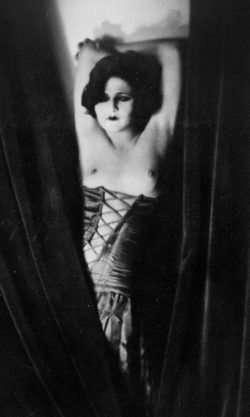
Photo: Madame d’Ora.
REVIEWS
The art of living – an impression on the subject
The Teatr A Part in Katowice (like the Kamienica Theater in Warsaw) draws inspiration from the place where it is based: a German cabaret once operated in the building they use. The show ‘I Died of Happiness’ begins unusually: with a presentation of the artist Anita Berber, whose character was the inspiration for the creation of the show. From the lecture given by the actress and the presentation she prepared, we learn that she was an extremely colorful character, called a scandalist because she constantly broke moral conventions. The performance itself is a kind of impression on her biography, immersed in the specificity of variety theater. ‘I Died of Happiness’ is remarkably reminiscent of Pina Bausch’s theater in its aesthetics: beautifully composed scenes, precision and expressiveness of stage movement. There are many group scenes and choreography in the spirit of a historical cabaret, the atmosphere of which can be imagined based on the descriptions and photos. The Variete Theater in Krakow still produces revues, but they are more of a typical entertainment cabaret. Teatr A Part juxtaposes well-known classical works, e.g. by Beethoven or Strauss, with aesthetics that are at the other extreme, because the artist’s freedom gives him the right to cross boundaries and think about the classics not only in a “devout” way. The only props on stage are black chairs. Thanks to their positioning, we can quickly find ourselves in a cabaret pub or an old cinema. The scenes of fashion shows are fantastic and also provocative, because both women and men come out wearing heavy makeup, high heels and corsets. In this performance, beauty is mixed with eroticism, but all this is intended to manifest freedom in art, which becomes life, and lives that can be subordinated to the performance of art. The only words that will be uttered from the stage will be an accusation of hostility towards crossing borders. The punchline will be provocative – the body becomes the costume, from which everything comes and on which the artist works, constantly using it to show art. ‘I Died of Happiness’ by Teatr A Part, directed by Marcin Herich delights and provokes – and that is what art is all about.
Joanna Marcinkowska, facebook.com/PestkaFestival, 05/2023
(…)
Let me go, torn, screaming,
That I die a billion years too soon,
And let him beat me in the last hour
My faithful wind, howling with grief!
(‘I’m screaming’ by Julian Tuwim)
‘I Died of Happiness’ by Teatr A Part is a manifesto of all those who want to lose themselves in this dance while dancing with death. Step on the edge of the roof and feel the taste of life. The form of performance inspired by the Dadaist avant-garde and cabaret seems, paradoxically, to touch on taboos as much today as it did a hundred years ago.
Sex, drugs and music. Next to Joplin, a waltz by Camille Saint-Saëns. Like Bergman’s chess game of Club 27. Next to delicacy, evisceration. Next to aesthetically classic fragments, there is a cold shower of (Ginsberg’s?) screaming, revealing the truth about fear, emptiness and insatiability. Eros and Thanatos live here in one house. Corporeality is postmodernistically stripped (or maybe that’s why it is extremely united?) from the sacred. As in Wojnarowicz’s photographs, freedom is mixed here with enslavement, rejection and limitations, and suffering with pleasure.
The creators balance contrasts very skillfully. They are, it seems, brutally (like a knife in the stomach?) – honest in their theatricality. You get the impression that they lose themselves in the game, engaging with it with every part of their being. That the words they say are really close to them. To such an extent that it is not so much a theater game as a play in the theater of life. A beautiful manifesto that does not confuse beauty with morality.
M, facebook.com/PestkaFestival, 05/2023
Naked reality
Marcin Herich’s play ‘I Died of Happiness’ interprets in a unique way the life of the controversial icon of the Weimar Republic – Anita Berber. It takes viewers to the surreal world of cabaret in the first half of the 20th century, where artistic excesses, fatalism and decadence dominate. The work perfectly reflects one of the key ideas of the avant-garde – the interpretation of life as a work of art. Painting vivid pictures using the play of the body, shadows, light, smell, as well as carefully selected music makes what is inexpressible expressed without words. The performance contains numerous references to painting, such as showing one of the actresses in a red dress, as if taken from Otto Dix’s painting ‘Portrait of Anita Berber the Dancer’. The way light was used made me feel like I was watching Edward Hopper in his creative process.
Nudity becomes another actor, referring to Berber’s characteristic naked stage performances in the space of German cabarets. Avant-garde theater, striving to discover new forms of expression, often violated conventions and norms applicable in art. Within it, nudity became a tool that allowed artists to express themselves directly and provocatively. People creating in the spirit of artistic trends such as Dadaism or Surrealism often explored topics related to the body in their works. Nudity on stage has become one of many ways to express these ideas and experiment with theatrical form and content.
The history of the Künstlerspiele cabaret, which took place in the premises of the current Teatr A Part, is only a starting point for a deeper immersion into the world of artistic exploration. Director Marcin Herich and his team conduct a spectacular reconstruction of pieces such as ‘Morphine’, ‘Cocaine’ and ‘Salome’, for which the performer became famous. He combines them with the modernity and style of Teatr A Part’s performances, creating something completely new and exciting.
We could observe the previous version of Variete’s approach to aesthetics during last year’s edition of Pestka, when Teatr A Part performed the sensational ‘Four More’. This year they did not disappoint us either, hypnotizing viewers with the plasticity and corporeality of their art.
O.P, facebook.com/PestkaFestival, 05/2023
The interior stage and the performance stage are one thing
The performance takes us back to the 1920s and the Weimer Republic, or more precisely – to the biography of Anita Barber, a German performance artist (today we could say – the godmother of performance, or maybe even Club 27), the last few years of her life full of scandals and stage creations. The theme and decadent atmosphere are almost ideally suited to the areas that A Part effectively colonizes, to neo-cabaret as a form of performance and a form to be freely shaped. On the one hand, we have real references, closer or further from the original (variations), on the other, a thoroughly modern theatre and performance. In ‘I Died of Happiness’, A Part definitely moves away from cultural codes and symbols, and emphasizes biography,’biographical moments’, as if intensifying the experience of time more. Allegories are needed, parallel lives and biographies are needed as tools for work and storytelling (even if they are stories about extremes – or maybe it is the extremes that can tell us the most about ourselves)? The latest performance also introduces several new forms, previously absent from this stage: the word invades non-verbal theatre (in a double role by Natalia Kruszyna), singing, live music (original instruments made by Tomasz Manderla).
Radosław Kobierski, Social and Cultural Monthly ‘Śląsk’ No. 8, 0/2024
A gesture that saves
The creator, in this case of theatre, decides what – even for a moment, before the lights go out – he brings (summons?) to life; as the one who performs before the audience, he can illuminate or hide something or someone: himself, another person, an object; he can extract from collective oblivion a past history, he can make his own emotion the subject of the performance. Maybe, but he doesn’t have to.
The creators of the play ‘I Died of Happiness’, directed by Marcin Herich at Teatr A Part, also seem to be aware of this power. The play, which uses the conventions of the twentieth-century artistic cabaret and revue in terms of drama and aesthetics, introduces the audience to the figure of Anita Berber – a German dancer and actress from the times of the Weimar Republic. The artist, who lived for only twenty-nine years, was a colourful, although tragic figure of the last century – she caused numerous scandals (related especially to her free approach to nudity and addictions), had an affair with Marlene Dietrich, and performed in theatres and cabarets. The creators tell the story of Berber not through her biography (although the play begins with a quasi-lecture introduction, during which one of the actresses reads out the most important information about the dancer’s life), but through a stage interpretation of her achievements – texts, choreography, performances and interviews. Based on preserved photographs and recordings, the performers reconstruct individual performances in the show, creating a kind of emotional and artistic portrait – they tell about Berber’s life through the prism of her work, using art to talk about the person. On stage, we see not only contemporary reinterpretations of twentieth-century cabarets and choreography, but also photographs displayed on the screen – they place the presented actions in a specific context, place and time. Herich therefore aims as much at factual reconstruction as at recreating the atmosphere of the last century and using this mood to arouse in the viewer a sense of real, almost physical contact with Berber’s art. This is most fully revealed in a scene reminiscent of a fashion show, during which actors and actresses, emerging from behind a black, drawn curtain, present subsequent silhouettes from the German artist’s performances. This is a very suggestive, powerful sequence of actions, which makes us realize how great the power of theater is: as a field of art that allows us to recreate, reconstruct or convey to the viewer – often in the form of experience – knowledge about what is no longer there or what remains completely invisible. The performers, emerging from the darkness (how important in revues), from behind the curtain, reinterpreting on an almost empty stage the work of Berber – previously unknown probably not only to me – emerge, as it were, from non-existence, from nothingness, “bringing” that part of the past that even evades the thick school textbooks. The actions of the entire team thus extract a specific character from the thick darkness, place it in the light, save it from oblivion. However, theater equips us with an effective weapon to fight the Grim Reaper, to tear the remnants of (someone else’s/our) life from its hands and to perpetuate it in collective memory. The performer, performing before the audience, strives for existence: his own or someone else’s (like in ‘I Died of Happiness’); each time he carries the memory of someone, elevates someone’s, often forgotten, story. The actor emerges from the darkness, later disappears back into it, but for a moment, even a short one, even the shortest, he effectively illuminates something that would remain in the shadows without him.
Kamil Bujny, zakladmagazyn, pl, 08/2024
Dance macabre
She was one of the most charismatic artists of the cabaret scene of the Weimar Republic, a forerunner of modern dance, an actress of German silent cinema, and finally a great scandalist of her time. Anita Berber, because that is who we are talking about, lived a short and intense life. She translated the darkest areas of human existence into the language of dance. Her character – somewhat forgotten and underestimated – was recalled in its latest, anniversary performance by the Katowice Teatr A Part. “I Died of Happiness” is a stage impression of Berber’s life and work, as well as a clear manifestation of the values that have seemed to determine the direction of Marcin Herich’s team’s explorations for twenty years. These are: uncompromisingness, independence, artistry, interdisciplinarity. The twenty years of Teatr A Part’s activity and the thirty years of the festival organized by Herich encourage reflection on the function, ontological status and the balance of profits and losses of an off-theater, authorial, implemented without institutional support. Berber, as an icon of the cabaret underground, pursuing her passion for dance in defiance of current fashions and aesthetics, appears here in a way as the patron of this type of risky, artistic and existential activities.
Marcin Herich’s new project is a chamber performance combining cabaret-revue aesthetics with a performative lecture. The premiere of the performance took place during this year’s edition of the PESTKA Festival of Avant-Garde Theatres and Culture at the Cyprian Kamil Norwid Theatre in Jelenia Góra, although it seems that it was the stage of the A Part Theatre that gave it the right shape and atmosphere. No wonder – the annex of one of the Katowice tenement houses, which has housed the theatre since 2013, is a place with a truly artistic and intercultural origin, although it also reminds us of the difficult, wartime period in the history of the city. In the years 1907-1915, the building on 3 Maja Street housed the first silent cinema in Silesia, while during World War II, the German cabaret Künstlerspiele had its headquarters there. The character of the place and the spirit of those times have so far been alluded to by the Herich Theatre in three revue-cabaret performances, such as: “Künstlerspiele. Scenes from the Great War” (2014), “In the Jungle of History. Variete” (2015) and “The Last Days of Mnkind” based on the drama by Karl Kraus (2018). The last two were produced as international co-productions. The performance “I Died of Happiness” can also be traced back to a fascination with the aesthetics and aura of cabaret in the first half of the 20th century, although the timeless issue of female freedom and independence resonates just as strongly here.
Natalia Kruszyna introduces the audience to the decadent world of Anita Berber. Her short, performative lecture is an essential part of the performance – it is from the content and images contained in it that the actors will draw in their etudes. In this first, still verbal story, the image of the charismatic artist is combined with a personal portrait of a courageous, passionate woman, but also addicted to drugs (Berber will dedicate a cycle of her dances to them). Anita Berber had excellent technical foundations – her teachers were Emil Jaques-Dalcroze and Rita Sacchetto. She made her debut as a cabaret dancer in 1917, and a year later she appeared in the first film by Austrian director Richard Oswald, who regularly entrusted her with the roles of protagonists in his silent pictures. Berber also worked as a model, posing for “Die Dame”, the first illustrated magazine in Germany. However, her greatest passion was dance – modern, expressionistic, inspired by personal experiences. “I dance death, disease, miscarriage, syphilis, madness, dying, infirmity, suicide,” she was supposed to have confessed. Her trademark was nudity, flaunting eroticism, and creating dramatic choreographies – performed individually or in a duet. With her second husband and stage partner, Sebastian Droste, she created a series of performances from the danse macabre cycle, taking up the themes of death, disease, macabre, suicide, addiction, and madness. These choreographies found their poetic and visual reflection in the book “Dances of Vice, Horror and Ecstasy”, published by the duo in 1923. It was an extremely original, innovative project, in which the artists were very involved, although their private paths diverged the same year.
The references to Berber’s biography and work in Marcin Herich’s new performance have something of a séance about them. Instead of a chronological presentation of the artist’s fate, we get a collage of images, gestures, motifs referring to her work and image. Individual scenes – in which the key role is played by bodies, individual and collective choreographies, sound and costume (or lack thereof) – have the character of a ritual evocation of the old times, the decadent aura of the interwar German cabaret, its creators, and their descendants. It is not without reason that the first of the collective creations was entitled “Ghosts Among Us”. It can be read as a direct reference to cabaret heritage – both that related to the theatre’s seat and that considered in a broader dimension. The choreography consisting of synchronously performed stage gestures and pauses (when the actors stop on the chairs used in this scene, they look directly at the audience) is an invitation to engage in a dialogue with this world – which the Teatr A Part team does in subsequent moving images. The axis that unites the cabaret revue is the character of Anita Berber, which is why many scenes refer to her dance performances (“Salome”, “Cocaine”, “Suicide”, “Morphine”), stylisations (parts of “Modenschau I” and “Modenschau II”) or the beginnings of German cinema (scenes “Kinematograph” and “The Blue Angel”).
Berlin in the twenties, which Berber absorbed, was on the one hand a mecca for artists and the European capital of nightlife, and on the other a city on the verge of collapse, immersed in an economic and social crisis. The residents were reminded of this instability by posters in the memento mori style, hung up by the then Ministry of Health, calling on the dancing part of Berliners to come to their senses. Although Berber belonged to this rebellious group, she constantly evoked the element of death in her performances – until the last dance, during which her stage representation of agony turned out to be a prelude to the real one.
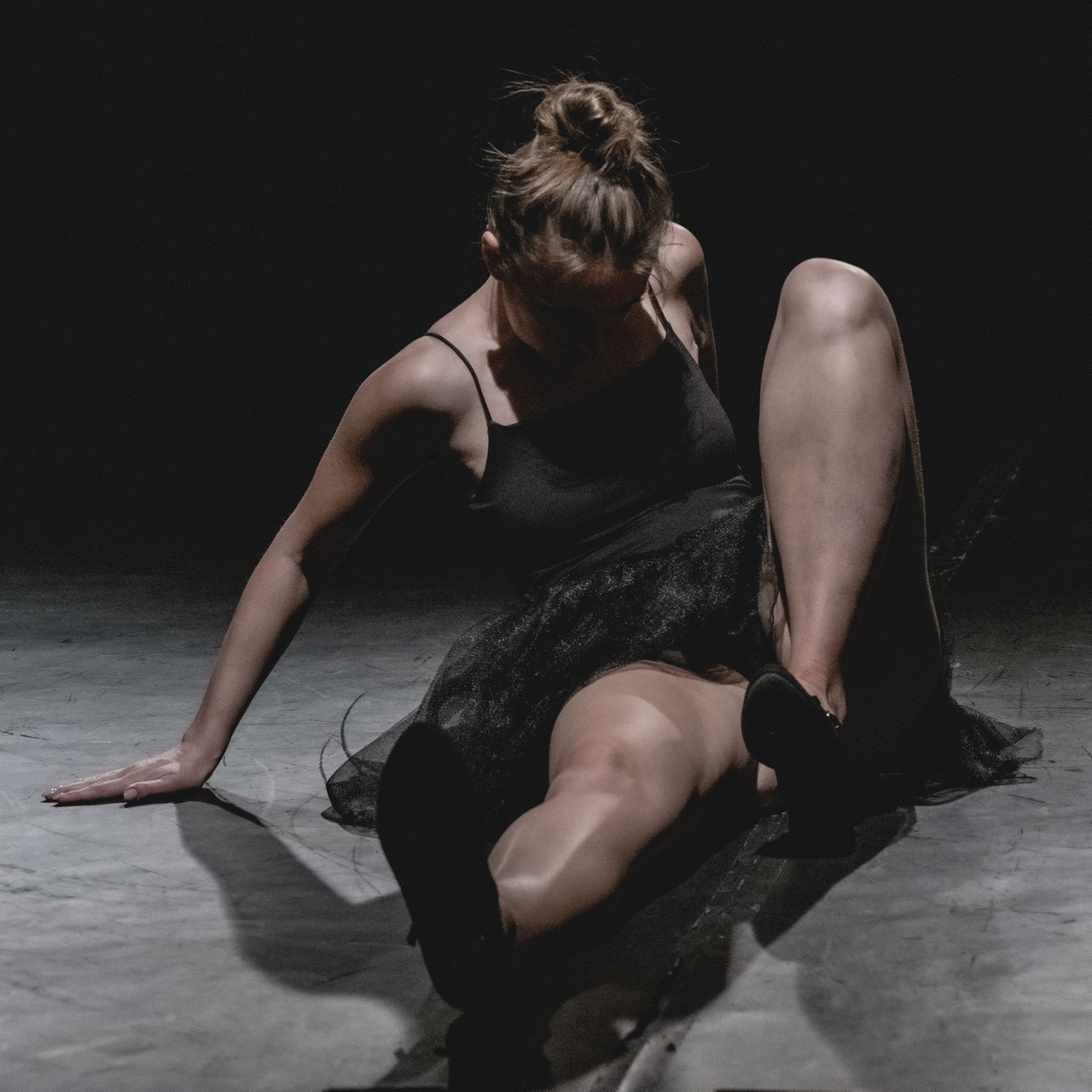
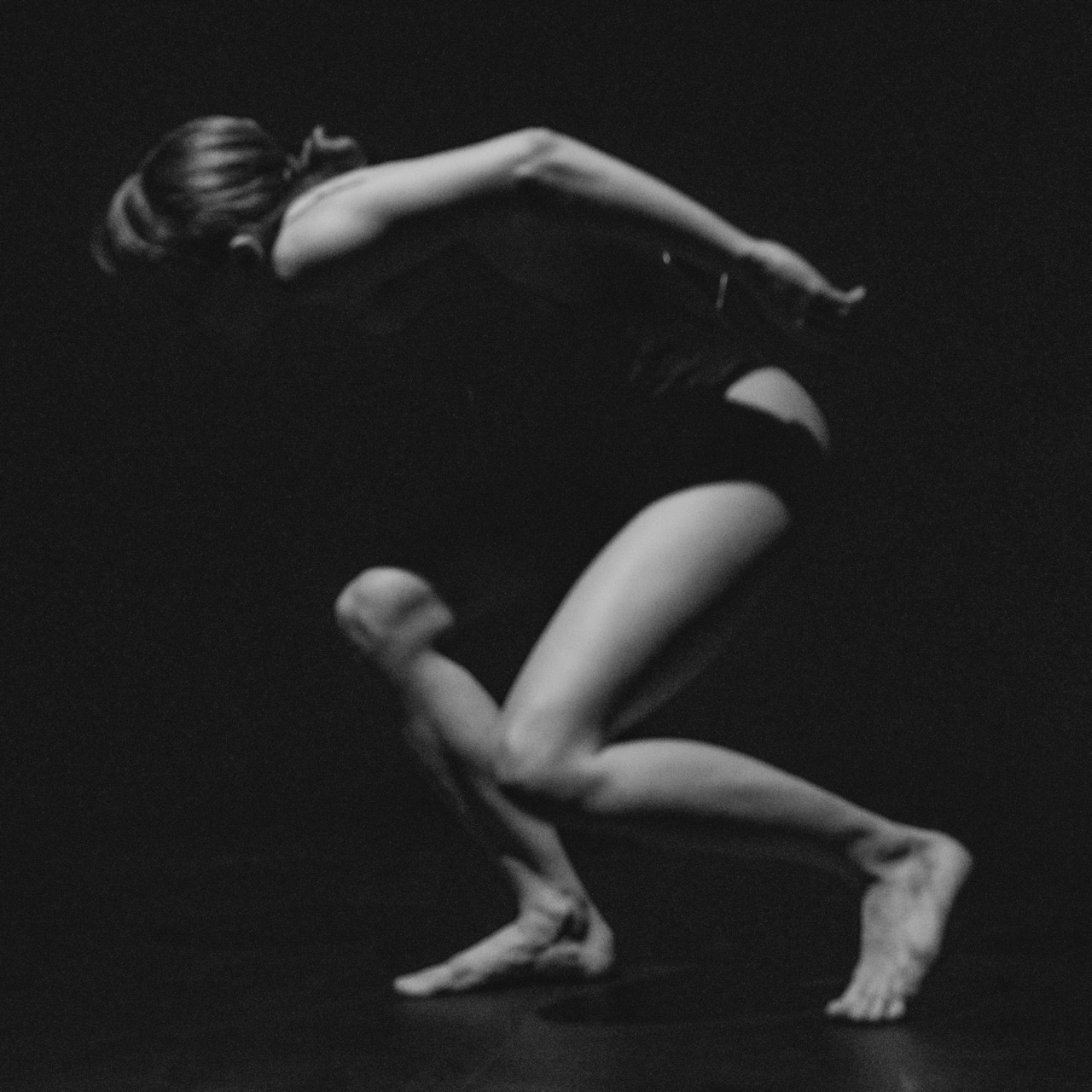
The gesture of falling, characteristic of many of the artist’s choreographies, also becomes a recurring motif in Herich’s performance. The element of death is perhaps most strongly manifested in the reconstructions of the dancer’s performances created by the group. Although the actresses and actor who create them avoid literalism – they use a chosen motif rather than a whole set of signs recorded in photographic documentation – Berber’s constant oscillation between life and death (even in a grotesque form) is present in almost every one of these interpretations. In “Salome”, Karolina Wosz dances with a black veil covering her face – it becomes a symbol of mourning and crime at the same time. The veil (quite often used by Berber) replaces the blood with which the artist’s naked body was painted in the original performance. In “Cocaine” – one of Berber’s most famous performances to Camille Saint-Saëns’s symphonic poem “Danse macabre” – three ballerinas in black (Katarzyna Gogacz, Karolina Wosz, Alina Bachara) try to keep their own bodies in a rigid, conventionalized form, which ultimately ends in defeat and symbolic fall (Berber also fought such a battle with her own body in “Cocaine”). The subject of death is directly evoked in the macabre duet “Suicide” (originally performed with Sebastian Droste), which is recreated in a minimalist version by Krystyna Szymura and Grzegorz Król, as well as in “Morphine” in Zuzanna Łapka’s excellent interpretation, which activates almost every inch of the trembling body.
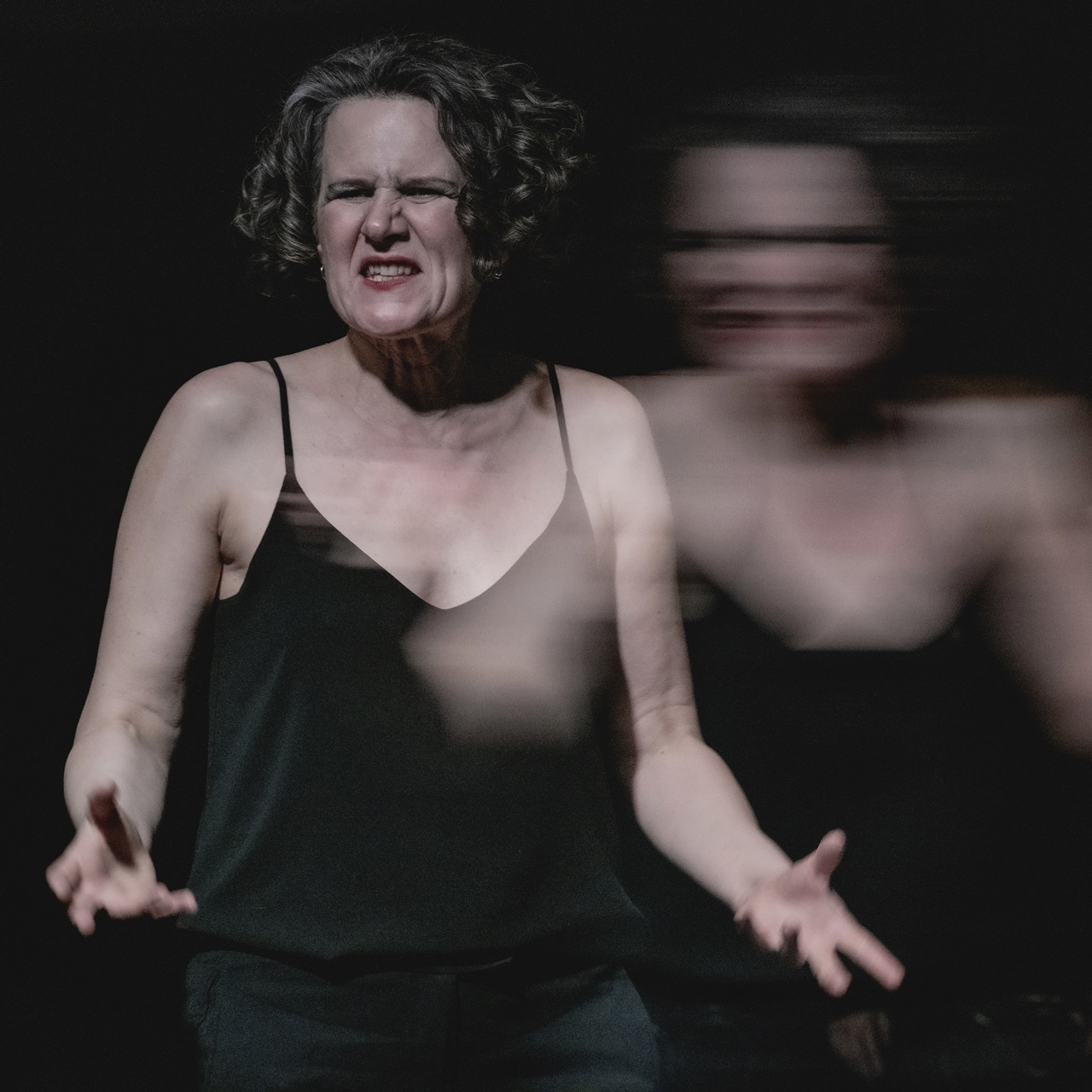
In “I Died of Happiness”, Marcin Herich creates a multiple portrait of Anita Berber, showing the whole range of her artistic images (including one of the most famous by Otto Dix), attributes (such as the famous corset worn below the breasts) and activities (apart from dance, there are references to her film career). The director also tries to place this unusual biography in a new context, looking for different points of reference for it. In one of the scenes, Janis Joplin and hippie culture are mentioned – as the first post-war movement to manifest moral and sexual freedom, close to the attitude of the Berlin decadents. Berber focused on truth – the truth of the body and the truth of art. During her life, she was met with misunderstanding, her work was covered up by the label of a scandalist and drug addict. The audience perceived her primarily as a “naked dancer”, not noticing that in her choreographies she boldly drew from her own experiences, blurring the boundaries between art and life. If her identity as a performer were being shaped today, Berber could shout her frustration from the stage, as Natalia Kruszyna does in a provocative monologue that takes up the theme of false bourgeois morality. It is extended in a significant final scene, in which the collective choreography from the beginning of the performance is repeated, but in a sauté version.
“I Died of Happiness” is the quintessence of the cabaret-revue interests of Teatr A Part. It reveals not only the extraordinary energy of the ensemble, but also nostalgia, which becomes the leading note of the created images. The actors perfectly balance between different moods – from tragedy, through melancholy, to grotesque and black humor – proving once again that artistic cabaret is not just a relic of the past.
Magdalena Figzał-Janikowska, “nietak!t” no. 1, 2024
Photos: Maciej Dziaczko
open gallery view video