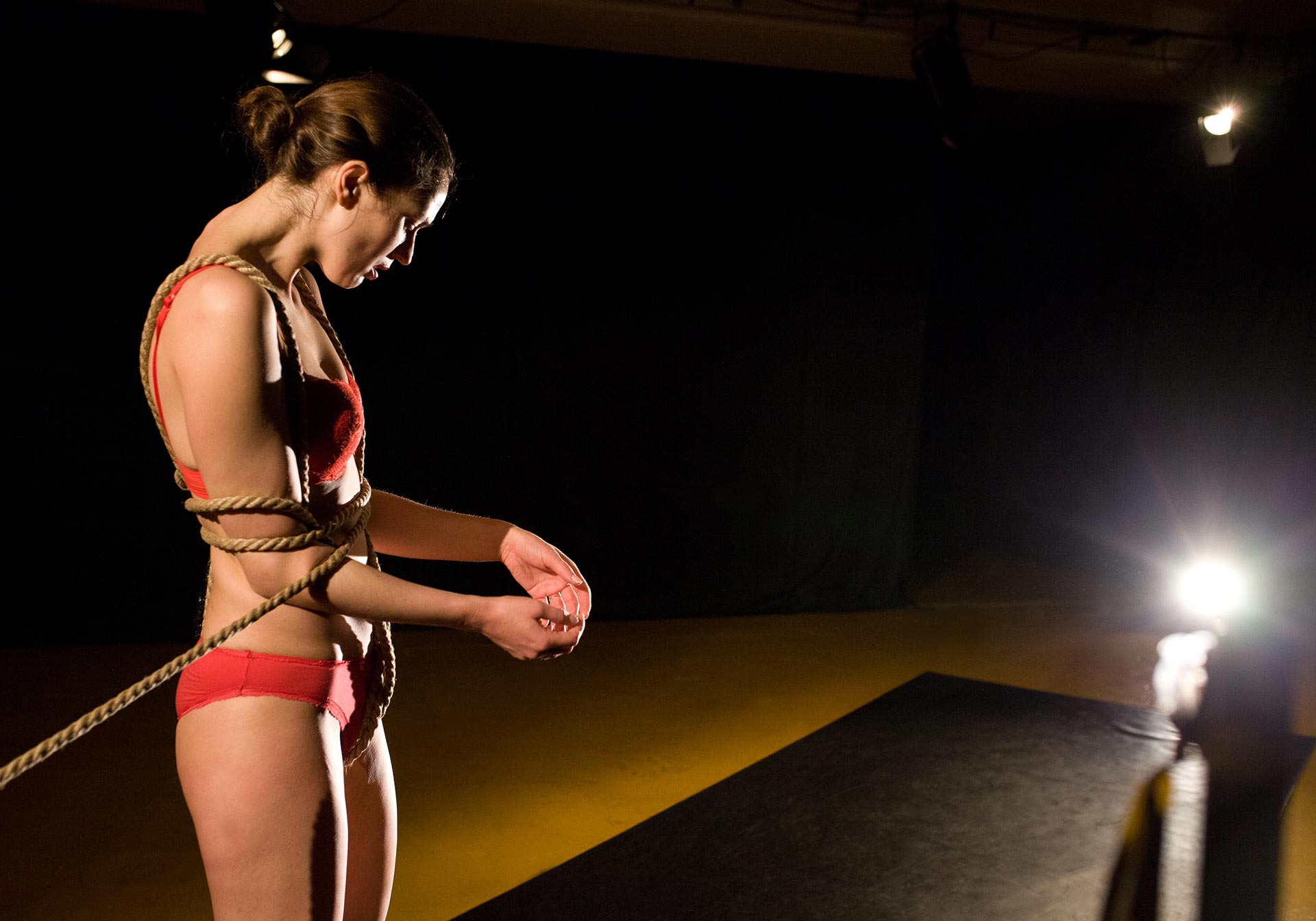
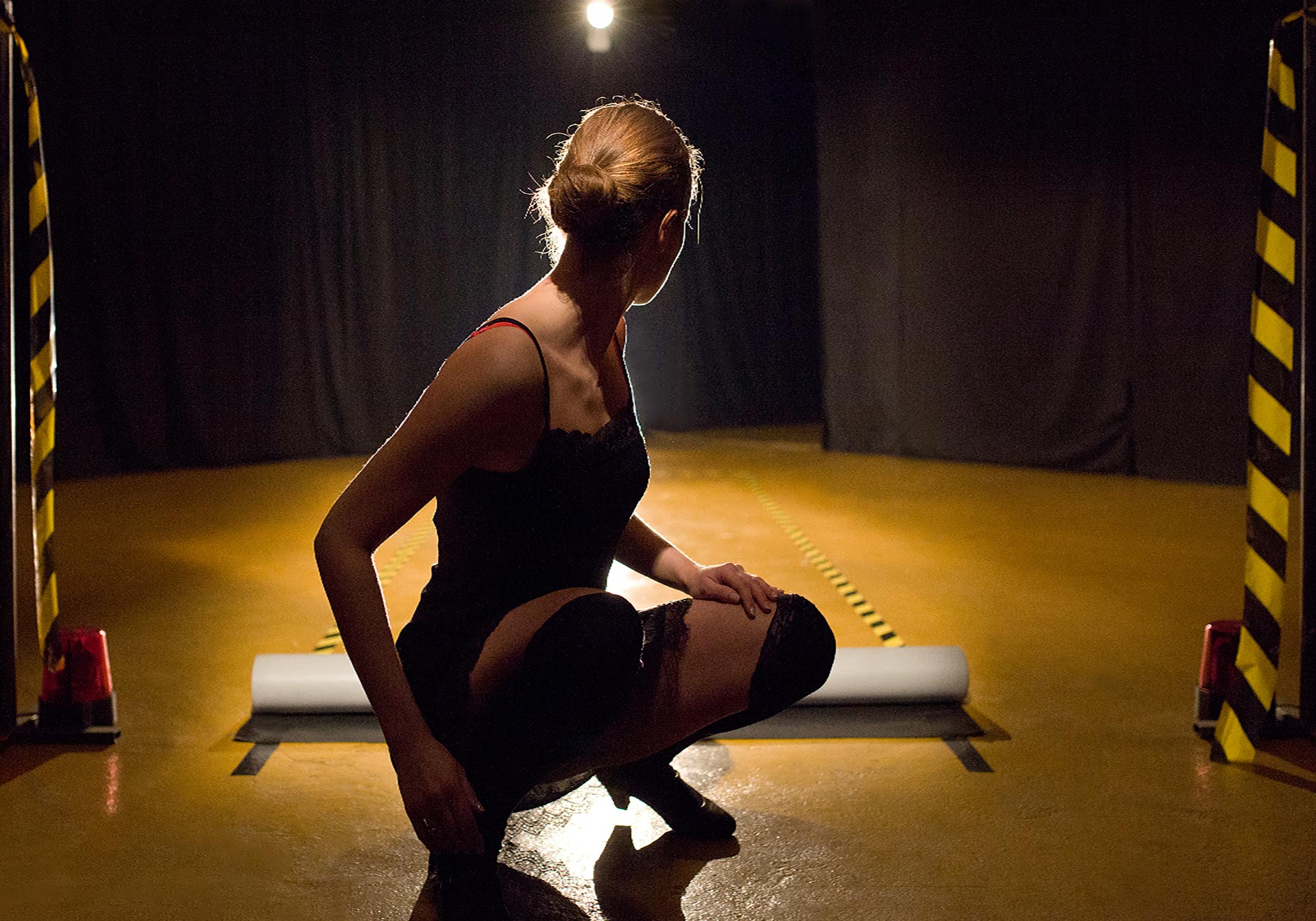
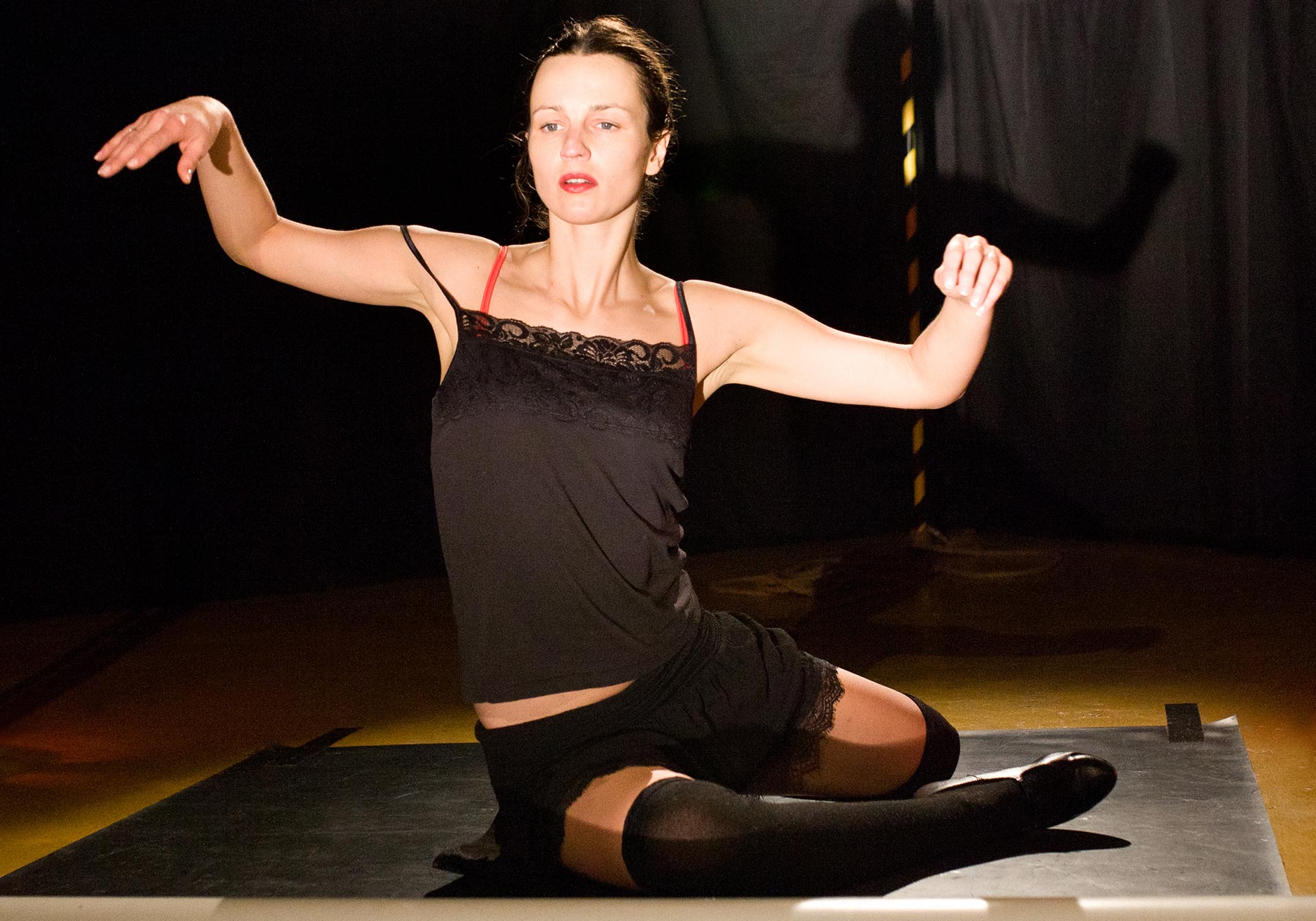
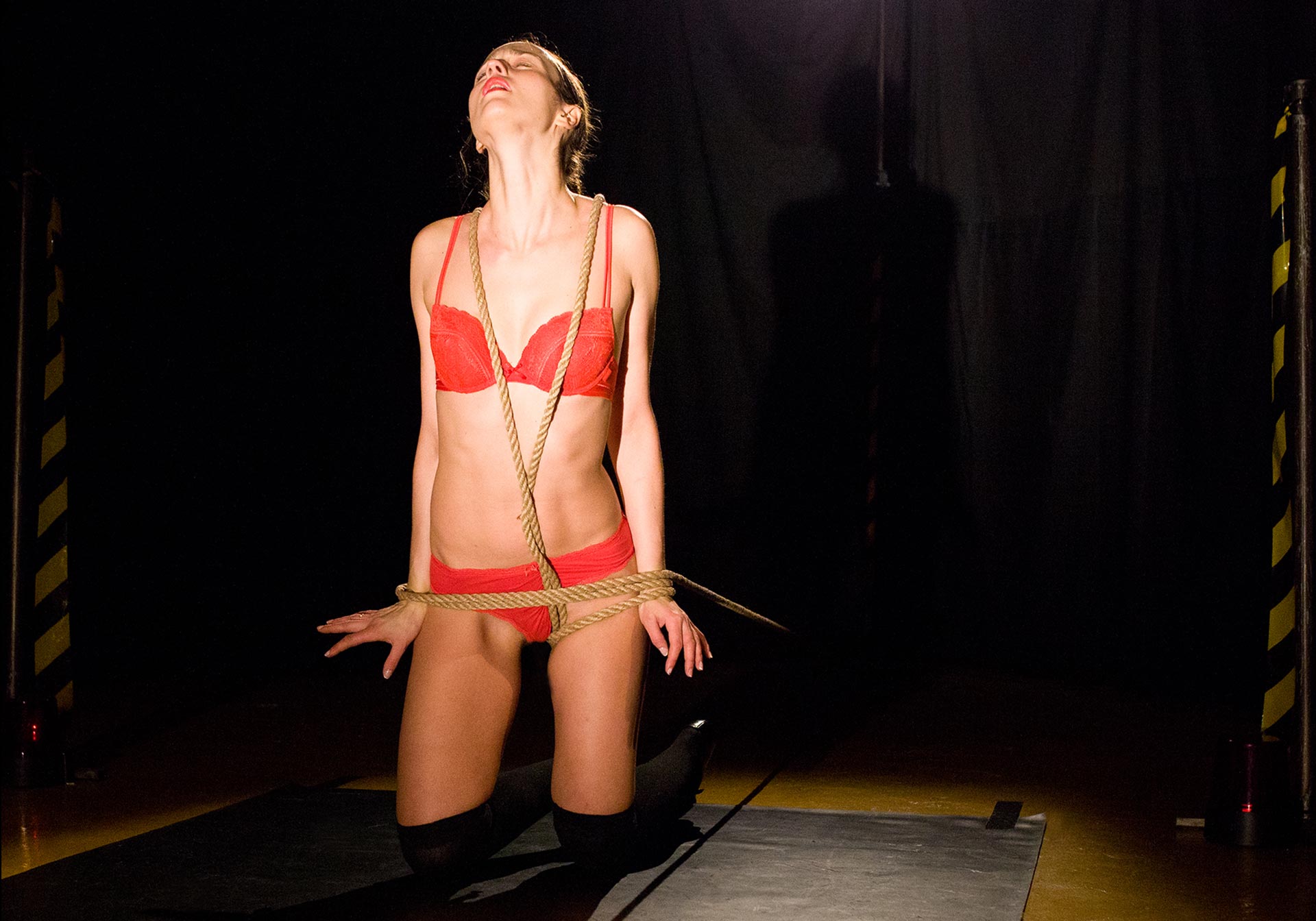
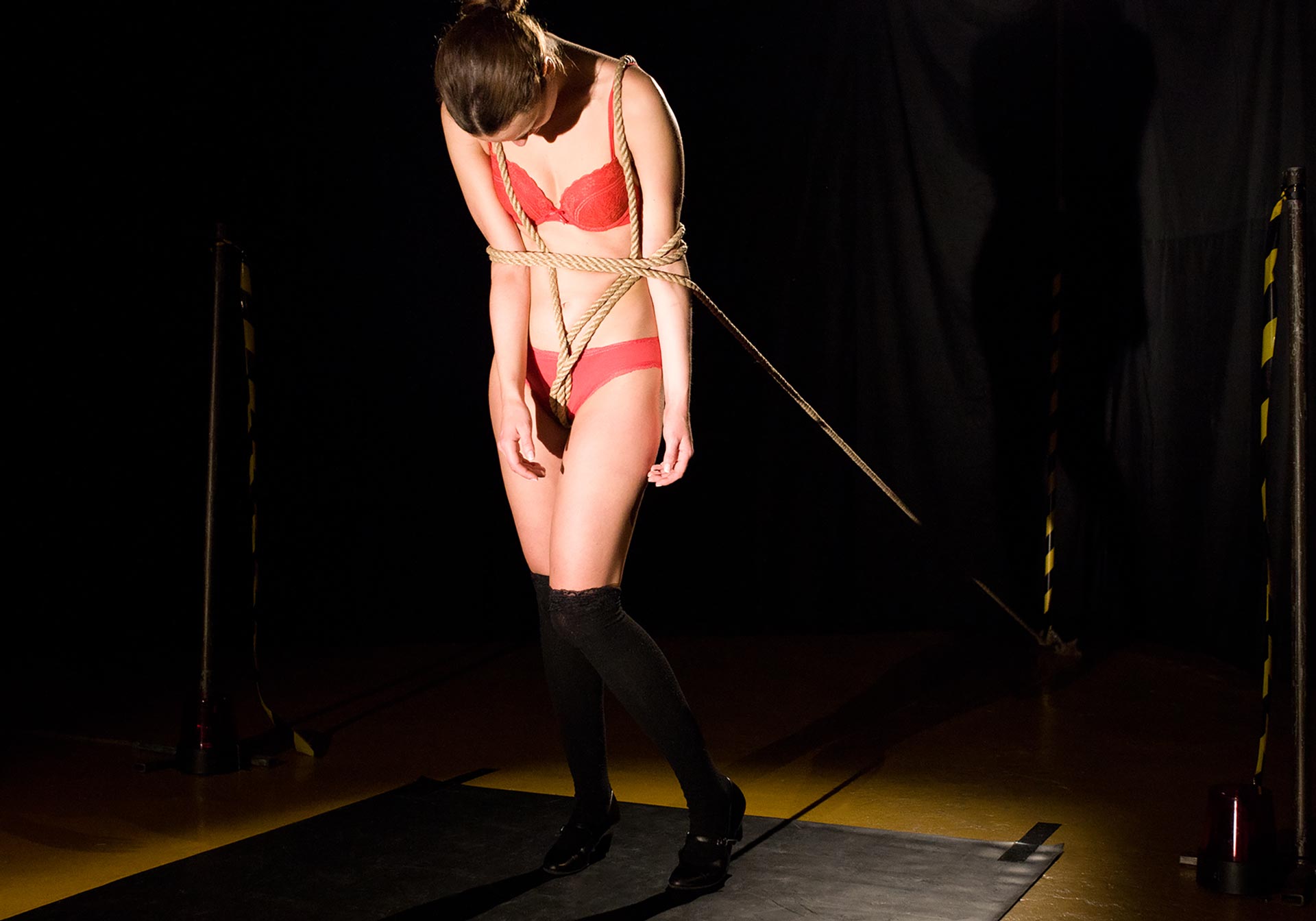
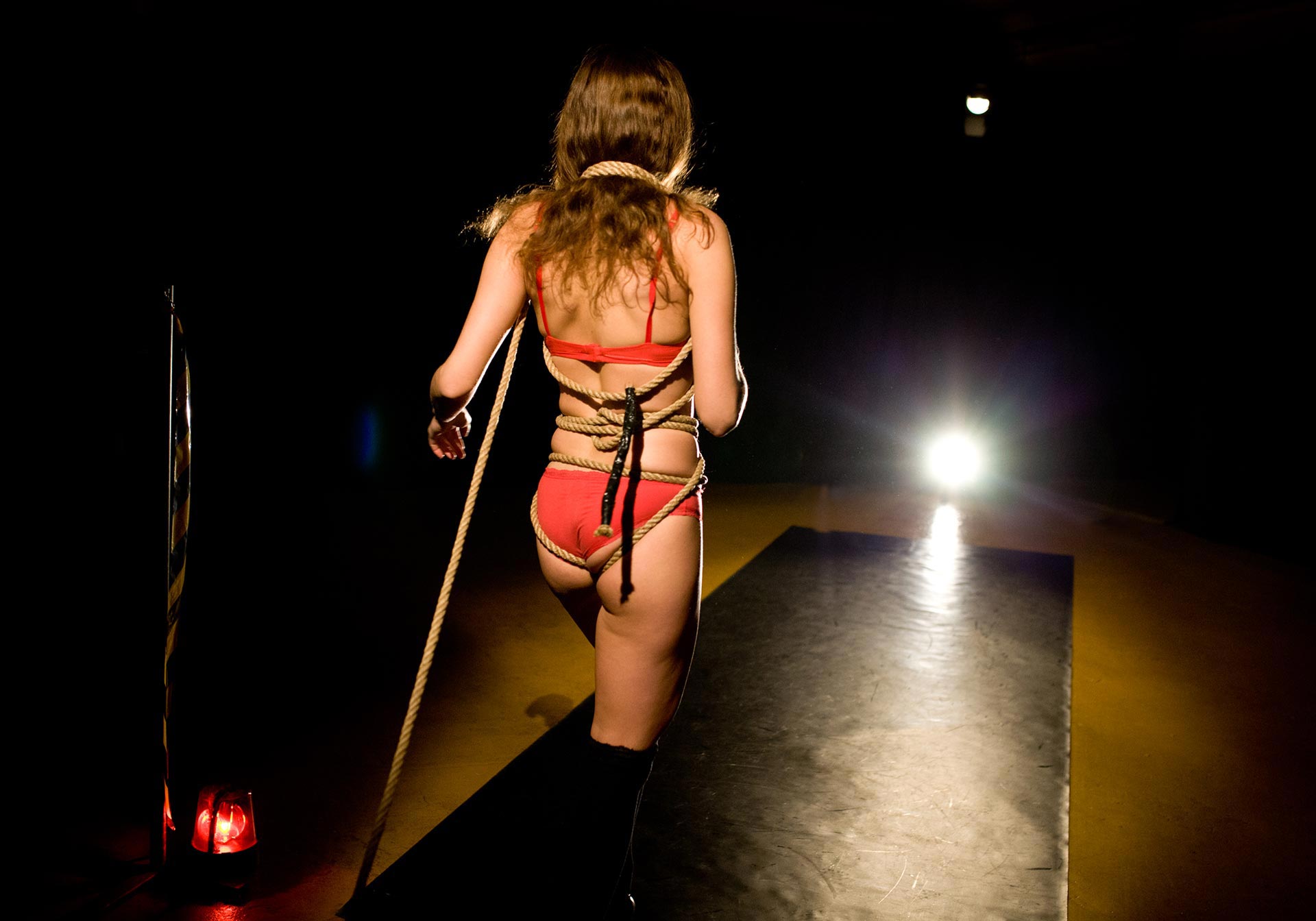
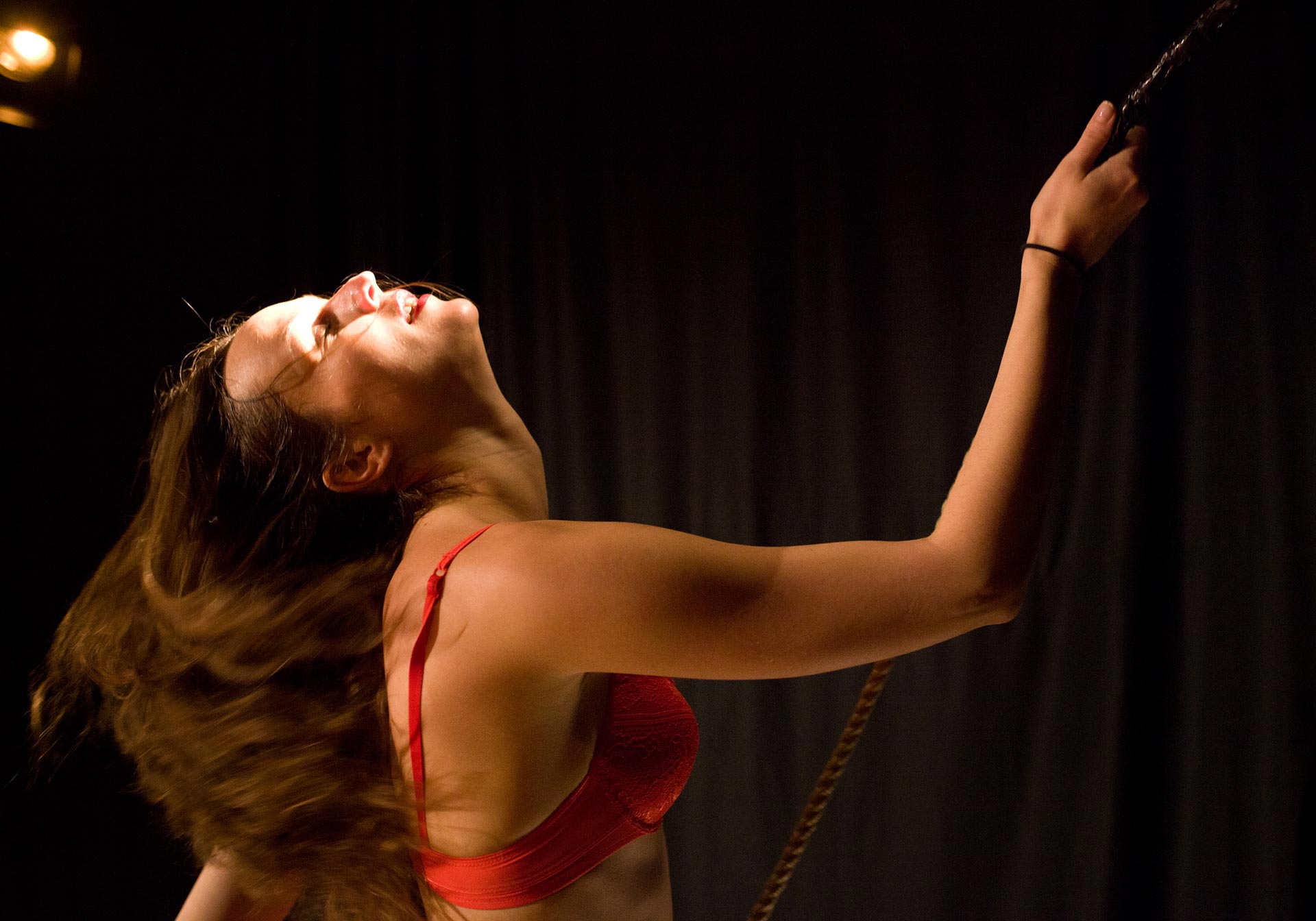
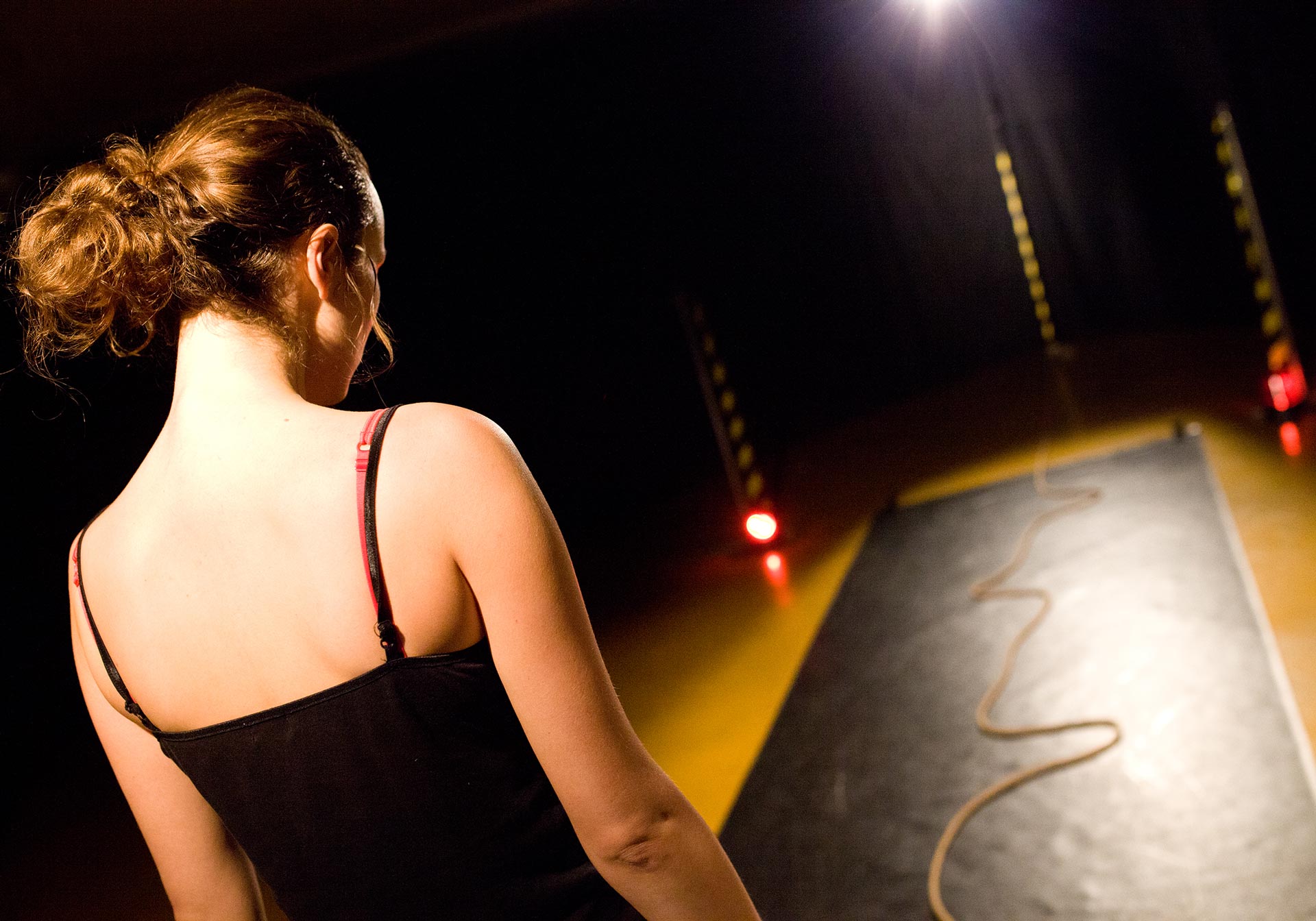
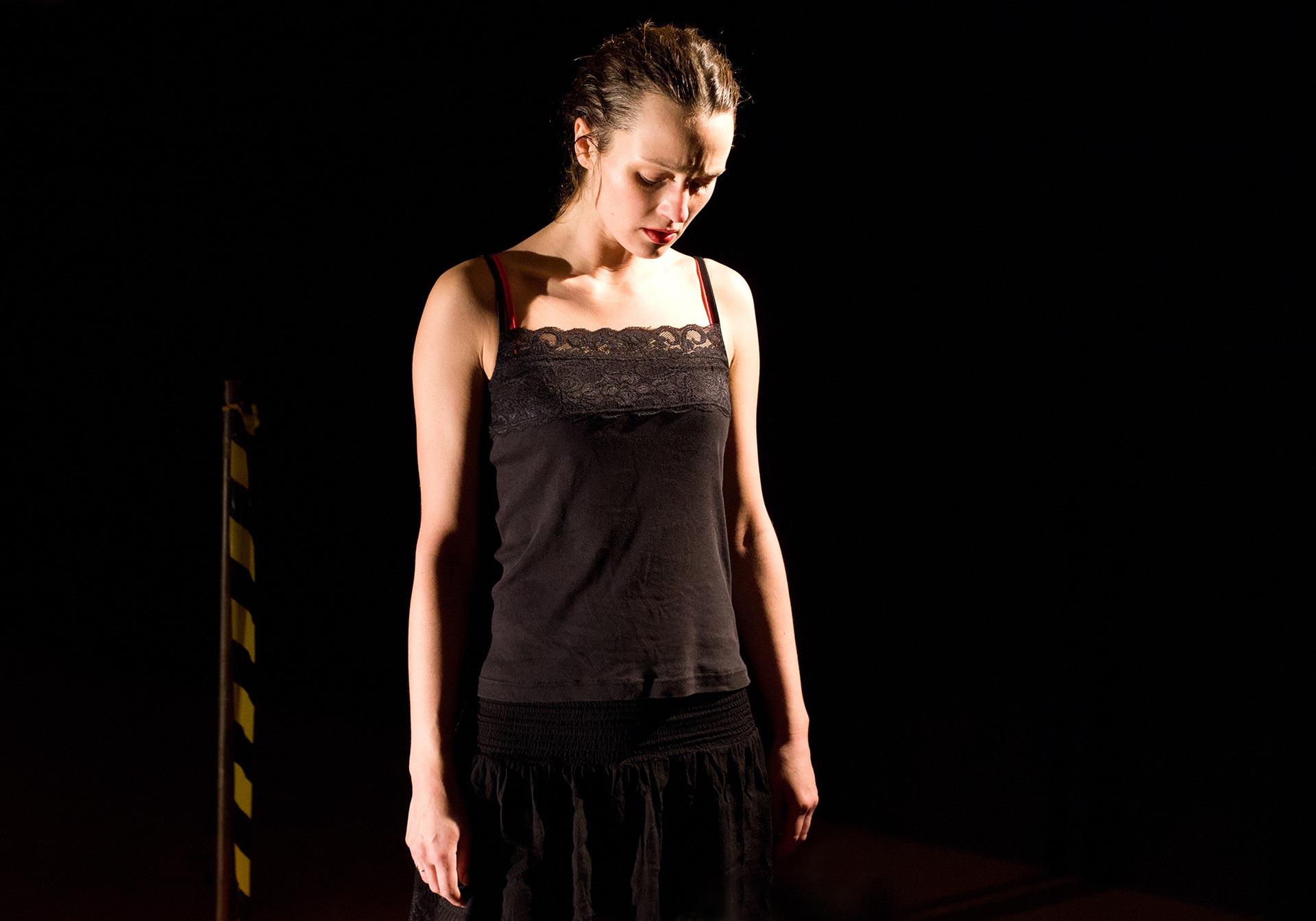
“Bonds” is a wordless solo show by Marlena Niestrój, combination of theater, dance and performance art motifs with bondage aesthetics. The performance is a personal reflection on life entanglements and forces involved: existential and social as well as an unique strength of an individual experience – of empiricism, which torn every human life. The “Bonds” viewers together with the protagonist of the story take a part in a metaphorical initiation journey. During the journey, as in life, extremes – seemingly opposing forces: pleasure and suffering, freedom and shackles, vitality and memento of death complement each other, and, literally, intertwine and entangle.
script and direction: Marcin Herich
stage moving, choreography: Marcin Herich and Marlena Niestrój
acting: Marlena Niestrój
music: fragments of pieces by J. S. Bach, David Lynch and Christblood
first night performance: Katowice, Poland, 2016
duration of the performance: 40 minutes
PRESENTATIONS
– 19.02.2016, Katowice, Poland (first night performance),
– 4.03.2016, Katowice, Poland,
– 28.05.2016, Katowice, Poland,
– 12.06.2016, Katowice, Poland (International Performing Arts Festival A Part),
– 24.09.2016, Katowice, Poland,
– 5.11.2016, Katowice, Poland (Metavera Art Festival),
– 20.01.2017, Katowice, Poland,
– 22.01.2017, Poznań, Poland (Teatr Ósmego Dnia),
– 21.09.2017, Katowice, Poland,
– 30.09.2017, Santo Domingo, Dominican Republic (Mamey Gallery, International Contemporary Dance Theatre Festival Edanco),
– 5.01.2018, Katowice, Poland,
– 7.12.2018, Katowice, Poland,
– 14,15.12.2018, Eindhoven, Netherlands (Art House, Seasoning Winter),
– 12.09.2019, Tychy, Poland (Teatr Mały, Tyski Festiwal Teatrów Niezależnych Andromedon),
– 15.09.2019, Rovigo, Italy (Teatro Studio, Opera Prima Festival),
– 7.03.2020, Katowice, Poland,
– 12.08.2020, Zadar, Croatia (Church of Saint Nikolaus, International Festival of Contemporary Theatre Zadar Snova),
– 25.11.2020, Zagreb, Croatia (online, Festival of Alternative Theatrical Expresion Faki)
ABOUT THE PERFORMANCE
Is there anything more important than realizing and noting that we live in a complex network of connections? That experiencing life, at every moment, we direct our feelings and thinking on dependencies, relationships, relationships and their various shades?
This is what “Bonds” say. Here, these relationships were reduced to the single bonds of the heroine of the monodrama, becoming a relationship laboratory in which we carefully examine the various layers of this network, untangling the knots of relationships one by one. The viewer is drawn into the process of systematically exposing masks, social roles and relationships. We accompany the heroine in slowly and methodically reaching the deepest. Participation in this game raises the question: is naked truth possible? Whether this journey to discover the essence of identity outside social conventions will give the heroine freedom from entanglements, or on the contrary: will show that there is no escape from the bonds, only in other bonds, because no one can afford the luxury of being a lonely island. And in truth, being a lonely island is not a luxury.
The space of “Bonds” is characterized by simplicity: no monologues and dialogues, interaction of the heroine with other actors or actresses, minimalist stage design. It is as if the world shown in the performance has been reduced to elements that are fundamental. We reject unnecessary hype to look carefully at the basic issues. These issues are the study of possible human relations with the world, playing conventions, entanglement in relationships, but above all the search for a female identity in relationships and beyond.
But the simplicity of the world of “Bonds” invites us to dive even deeper. In the very core of human existence and see in it the ambiguity of all our relationships, which inevitably build our identity, while confronting us with the depth of our loneliness. Even in the most intimate relationship we are lonely, never the shell of our body will not be pierced by the body of another person, never our thoughts during the lonely night will not be fully understood by her mind, never her warmth will finally comfort us. In every relationship we remain lonely, and in this relationship is similar to death, which is for us the greatest test of loneliness.
Anna Gierlińska & Mirosław Piróg
REVIEWS
I saw an intimate and nice performance from Marlena Niestrój during the evening. The performance tells a shrewd story about a woman who realizes her own consciousness and femininity.
The performance starts with classical music that brings a sense of harmony and looking of for perfection. At the beginning, we are all perfect or, at least, believed to be perfect. However, harmony is not permanent. Being able to handle events and emotions that break our harmony allows us to become strong enough to understand our own personalities and hearts, both through complicated and sensible constructs. A vulgar-looking dress along with black stockings and underclothes like a black skirt and top matched with red underwear. Somebody once said, if there is a gun on stage it will be used. I thought this opinion prosaic at that time, but it seems inevitable and cannot be avoided. The happening should happen. The story should be told. Red underwear behind the gray dress should be shown. It is a step across the border when the harmonious music stops suddenly, both in the performance and inside of me. I was touched by this simple but precisely executed and symbolical movement. When the music stops, it is not necessarily a sign of harm. It is a sign of an important moment where silence is needed because the silence speaks volumes. Something absolute is about to happen. It is wondrous how simple is to step over the border only to discover that I am on the other side already. The stunned silence becomes ordinary silence. There is always something waiting for us on the other side. This time there is a rope. Is it Ariadne’s thread, a navel cord or a sex toy? Death and (re)birth are both connected to it. Is it sexuality itself? First she steps upon it, trying to know, to understand, and becomes provocative and a leader. Who dares to twist a rope upon herself, and who is not afraid of it. However, I do not feel the rough sexuality, since she refers to it in such a gentle way. She remains sensible even with a mix of challenging colors and tools.
She undresses herself. It is a nice moment. Very natural. She is herself as she is, no less, no more. It is rare that somebody wears their own nudity in such a natural way. It is often difficult to accept and to look good while nude because nudity is in itself so uncomfortable. Real nudity, in front of an even very intimate and small audience is more difficult. The peep show was more provocative and quite long but had a message – Everything should be tried and if you feel strange with it, you need to experiment with it for longer.
Is something being strangled by liberty? Why is the cord wrapping around her neck? I cannot watch this because it hurts and I need air. I must think about the last word for a moment. What is after the happy end? What does one do with acquired knowledge? What is over over-the-border? After being naked, do you desire clothes again? Do you even need clothes again? She cannot be in a vulnerable condition for the long term. Time for a little game again, bored. No naive curiosity but rather stubbornness and something must be done. She puts the dress on again. There was quite a good turn-out but for what? Therefore, here she is again, more mature and more beautiful. The starting point was similar but not the same as the end point. Some of the audience does not look at her while she is getting dressed. Is this a contradiction? Is getting dressed a more intimate action than to undress? Sometimes it is. She revealed herself but now she has to return to her everyday routine again. It is painful but necessary for her. It would better not to follow her metamorphosis again, or it would be less spectacular. Seeing her preparing herself for a new day with a gray uniform.
The symbols could be exaggerated – the siren, the rope – but the performer finds the balance, filters it, and transforms it into something both personal and meaningful. At the end of the performance, I would like to congratulate the performer and give her a hug. Leaving the room, no one stepped on the black carpet playing field. It carried the weight of something symbolic, like sacred places do. It is like a lake of a swan, do not tread upon it.
Csilla Aradi, csillaworld.wordpress.com [Katowice, Poland]
The contradiction lies in the human nature, although it is hardly ever realized. The show entitled the “Bonds” by Macin Herich and Marlena Niestrój accomplished a large part of the self-discovery process for us.
Marlena Niestrój’s performance directed by Marcin Herich is a monodrama in the best sense of the word. Having limited means of expression, it does provide authentic emotional charge. It is a compact and mature show, that convincingly recounts inner human experience. It is significant that all happens with no help of words, yet has an extremely accurate and strong impact on the viewer.
The components of the show are the human body and a rope. They act as cognitive tools and undertake the actual mediation – they bring out unconscious states and allow to understand them. The “Bonds” as a metaphorical and initiation story seems to be a multistage dream of something new, of experimenting and trying. It is like experience that eventually transforms a person. An initiation rite is fulfilled, ended with person’s self-knowledge. The process itself is not revealed immediately, the monodrama starts with a carefree dance, idyllic Bach motives that bring anxiety. This is a kind of adolescence, not yet rotten, still naive and thus vulnerable to destruction. A sizeable rope, warning lamp and black tape, symbols of life entanglements, are waiting.
It inevitably happens what has to happen: as a sign of the New the heroine breaks the tape. The next part of the performance illustrates the process of individual entanglement up to its final boundaries. It makes one think of tug-of-war, testing its durability and usage possibilities. What is this rope now, and what may it be at the next attempt? Every movement seems to be triggered by curiosity. On the other hand, the word “no” is so hard to say and even harder to obey. Maybe this is because the licence and affirmation actually belong to the youth – they are required for entry into life, for getting initiated. However, depending on the psychological features, one may be led to something different: in The “Bonds” the heroine significantly recedes from her original condition, she becomes the opposite of ” the dancer” from the beginning of the monodrama. She chooses the most direct and radical path – she gives her body away and reveals her bareness. She founds there sexual fulfillment and pleasure, because her young, beautiful body contains a promise of domination. A tangible breakthrough occurs when the woman decides to bind her body with a rope. Such a decision is partly a consequence of the previous steps, each contributing to the deepening of self-knowledge.
Viewers of “Bonds” witness the knowledge that becomes a noose and only apparently implies a voluntary yoke. Winding the rope around the heroine’s neck symbolizes the experience of extreme empiricism. It’s like tightening the noose and … showing a diifferent, equally ruthless face of desire: total subjection and humiliation; lust that burns out and deprives of any power. One can’t claim that this psychological completeness – between delight and doom – certify untruth. The whole is a final attempt to get to know oneself in context of one’s own sexuality, which the authors of “Bonds” decided to show. The body, the rope, nudity – those are metaphors of entanglement that affect each individual to some degree. The question is just how far can such self-knowledge change a man?
Julia Kosmala, Na stronie [Katowice, Poland]
The node metaphor is one of those metaphors that have enormous aesthetic impact. Evokes opposing, sometimes contradictory associations, from the bond that connects, to suffocating entanglement. In the “Bonds” performance, this metaphor becomes not only content, but also an aesthetic form, where theater and dance, performance and bondage art overlap, while concealing and revealing each other. The dancer is tying her body as if taking possession of it. Accompanies him in gradually entering into the game of references: to what is absent, to a partner who never appears on stage. In this game, masculinity is revealed in contrast, in negative. In this way, the spectacle becomes an intimate journey, cruel in style of Artaud, through the deep ambiguities of the relationship of two people and two sexes, through the bonds imposed by culture and religion, as well as individual bonds that we accept so as to be able to function in the world in spite of everything. This monodrama is troubled by its brutality in exposing our present day. The heroine of the performance and its protagonist Marlena Niestrój is very expressive, both in dance and in interpretive power.
Maria Dolores Pesce, dramma.it [Rovigo, Italy]
“Bonds” is a body and leash solo by Marlena Niestrój, which combines theater, dance and performance with the aesthetics of bondage art. The show is realised by Teatr A Part, a Polish theater group founded in 2004, specializing in the study of human instincts and their relationship with the unconscious using non-verbal language.
Marcin Herich and Marlena Niestrój (husband and wife in life) created a study of movement directed by the former. A beautiful actress, tall, dark-haired, with a carved figure, takes us to a kind of fashion show on a dark catwalk, where, after crossing the border set there, she begins a journey between the mind and body, tethered, through bonds and obsessions that take the form of experience from the area of bondage, in front of the stunned eyes of the audience, who is trying to guess what the woman in front of her is capable of, what she can go about, how far she will undress (completely), how much she will tie (completely) until she is almost suffocated.
This experience is undoubtedly tiring, even from an interpretative point of view, because we see a person who does not spare himself, offering viewers his not only a performative, but also a subjective body: the audience is so close to her performance that he almost smells her animalistically. The performance evokes strong emotions, consistently maintained over time; it is stuffy, bad in its own way, composed of seductive, but also violent, self-mutilating gestures, which can undoubtedly divide viewers.
The recipient can ask himself a question about the moral profile of his reception (erotic or otherwise). The archetypal situation of surrendering, sacrificing, gradually plunging into masochistic dynamics, although it borders on the border of pornography, never exceeds it. What looks erotic never becomes pleasant and trivial.
Renzo Francabander, Paneacqua Culture [Rovigo, Italy]
Theater, dance and performance also appear in the performance “Bonds” of the Polish Teatr A Part. Supported by the dramaturgy and direction of Marcin Herich, actress Marlena Niestrój organizes a tangle of forces and contradictions that characterize life on the stage of the Teatro Studio. With the help of a rope, stylized door and light beam, with the initial and final echoes of symphonic music, the heroine expresses her statuary physicality. The wavy choreographic arrangement spreads the space by distinguishing between legal and illegal, in an adrenaline mixture of pleasure and pain. The rope shows a winding path. This is a clew, but also a leash and halter. It’s an umbilical cord, but also a chain. Which is equivalent to choking. “Bonds” is an extreme initiation ritual, told in a difficult language. Full nudity and erotic metaphor occasionally glance at the viewer, following the plot taking place in a narrow space.
Vincenzo Sardelli, Krapp’s Last Post [Rovigo, Italy]
Photos: Rafał Sandecki
open gallery view video